

How Much Screen Time Is Right for My Child? An Age-by-Age Guide (Based on AAP & WHO)
There's no single 'right' number for every child, but age-based guidance from AAP and WHO can help you set screen-time limits with more confidence.
"Is my child on screens too much, or is this okay?" — if you've ever quietly asked yourself that and then felt a twinge of guilt, you're not alone. Many parents wonder the same thing every single day. The good news: there's no single "right" number that fits every child, but there are age-based benchmarks from trusted health bodies that can help you decide with more confidence.
Why "how long" is harder to answer than it seems
In its 2026 update, the American Academy of Pediatrics (AAP) shifted its focus: rather than only counting minutes, it encourages parents to pay more attention to content quality, viewing context, and talking with your child. In other words, 20 minutes playing a color-learning game and then telling you about it is very different from 20 minutes scrolling videos alone. That said, time benchmarks are still useful as an anchor, especially for younger children.
An age-by-age guide (based on AAP & WHO)
- Under 18 months: AAP recommends avoiding screens, with one exception — live video chat (like a call with grandparents). WHO also recommends no screen time for children under 1.
- 18–24 months: If you introduce media, choose high-quality content and watch it together rather than handing over a device for solo use.
- Ages 2–5: AAP suggests about one hour of high-quality content per day. WHO recommends no more than one hour per day for ages 2–4, and less is better.
- Ages 5–7 and up: There's no hard number, but set consistent limits and make sure screens don't crowd out sleep, physical activity, meals, and free play.
WHO also stresses that children under 5 need at least 180 minutes of physical activity a day and shouldn't sit still for long stretches — screens are just one small part of a balanced day.
Quality matters more than the number of minutes
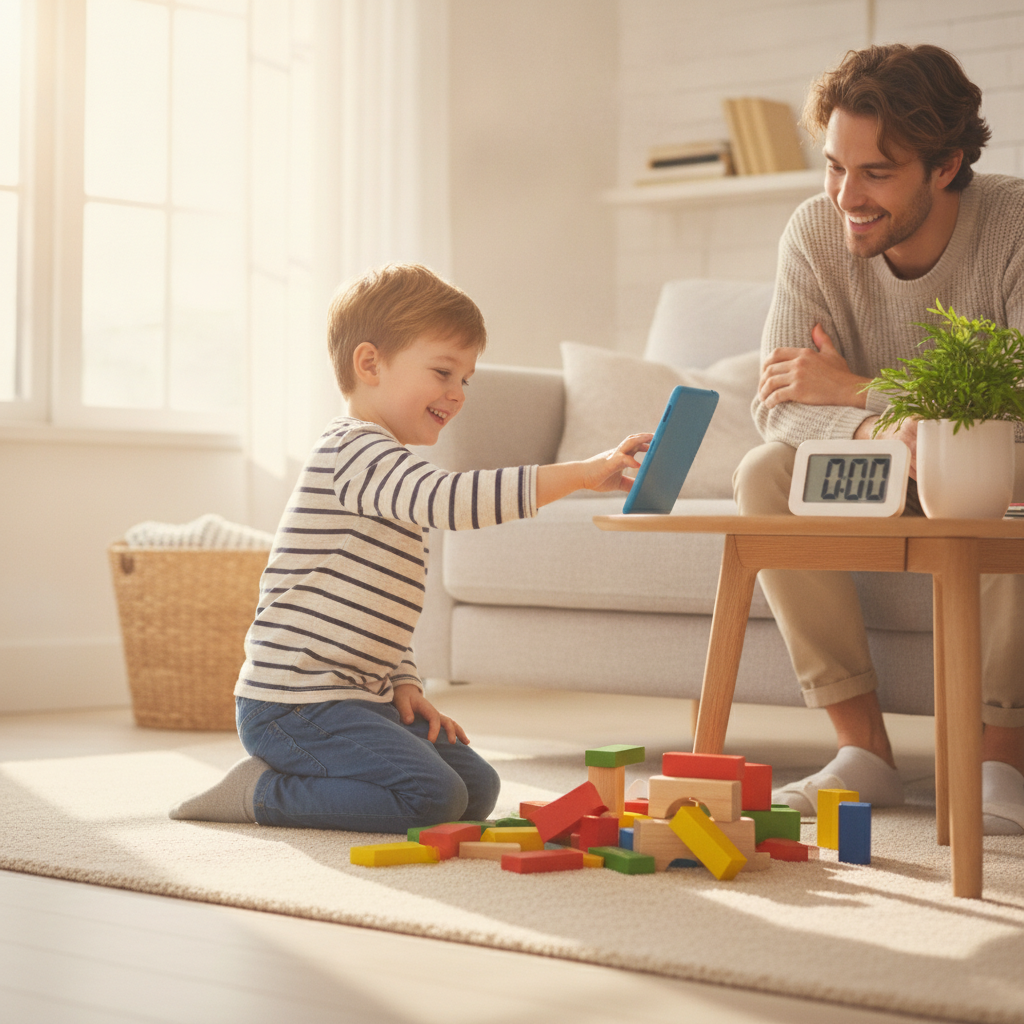
Research shows that when parents co-view or co-play and talk about the content, children get far more out of it than during solo use. You can play a few rounds together, ask a couple of questions, then step back and check in.
When choosing a game or app, favor content that sparks creativity and problem-solving and has natural stopping points. For example, Learn Colors with Wolfoo (great for ages 3–7) is a gentle way to practice color recognition, while Wolfoo Water Sort Puzzle is split into short levels, making it easier for both child and parent to stop at a clean point: "one more level, then we'll put it away."
To be honest: no game replaces active play, sleep, or family time, and no game will make your child "smarter." What games do well is offer a chance to practice a few specific skills within a limited, manageable window.
Practical tips + phrases to try
- Give a heads-up: "Five more minutes" makes the switch easier than turning it off suddenly.
- Use natural stopping points: "Let's finish this level and then put it away — which one do you want?"
- Acknowledge the feelings: "I know you're really enjoying this, and stopping is hard. We can play again tomorrow."
- Keep screen-free zones: AAP suggests device-free mealtimes and bedrooms.
For peace of mind: Wolfoo games are free to play, follow COPPA child-protection standards, and include parental controls; any ads are kept age-appropriate and non-personalized.
Frequently asked questions
Is one hour a day okay for a 4-year-old? About one hour of high-quality content a day falls within what AAP suggests for ages 2–5. What matters is good content that doesn't crowd out sleep, meals, and activity.
What if some days go over? A single over-limit day isn't a "failure." Look at the whole week and adjust gently the next day instead of blaming yourself.
Does watching together really make a difference? Yes. Talking about the content helps children understand more deeply and turns screen time into a moment of connection.
Sources
- American Academy of Pediatrics (AAP) / HealthyChildren.org — age-based screen time guidance (2026 update).
- World Health Organization (WHO) — Guidelines on physical activity, sedentary behaviour and sleep for children under 5.
- Child Mind Institute; Nemours KidsHealth — on co-viewing and choosing quality content.