

Safe & Smart Screen Time: 5 Healthy Device Habits with Wolfoo
Screens have become the #1 family fight. Five simple healthy habits — plus Wolfoo's parent dashboard — help kids use devices safely and in balance, without the battles.
Screens have become a leading
source of conflict at home: a 2026 survey found that around 9 in 10 parents
argue with their kids about technology every week — and technology has even
overtaken chores as the #1 family fight (StudyFinds, 2026). The good news is
you don't need bans — just a few simple habits and the right tools.
Here are five easy,
expert-informed habits, and how Wolfoo's parent dashboard helps you put them
into practice.
Key takeaways
•
It's less about “how many hours” and more about “what
and how” they play.
•
A screen curfew before bed is the single most valuable
change for sleep.
•
Co-play and keeping devices in shared spaces make kids
safer.
•
Favor content that ends on its own over endless feeds.
•
Use Wolfoo's dashboard to track and set an optional
limit — you stay in charge.
First: it's not the hours —
it's how they're used
In 2026, the American Academy of
Pediatrics moved away from a single fixed screen-time limit, emphasizing
content, context, and design over counting minutes (AAP, 2026). A game with a
clear ending, played with a parent, is very different from an endless feed in
the same minutes. So instead of obsessing over a number, focus on these five
habits.
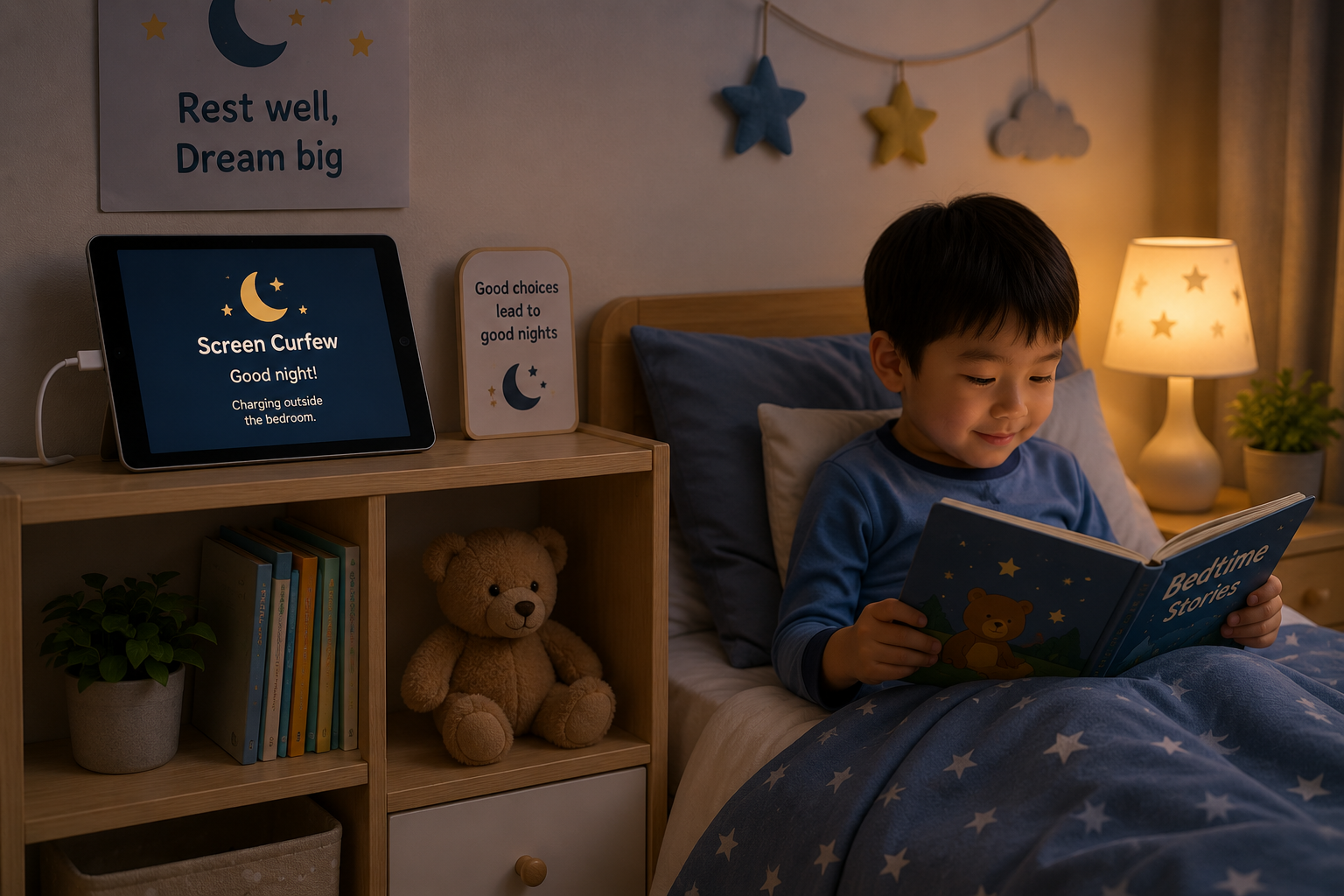
1. A screen curfew before
bed
This habit has the clearest
impact. Evening screen use is linked to less and poorer sleep; children are
more sensitive to blue light than adults, and a clinical trial found that
removing screens before bedtime improved toddlers' sleep (2024). The AAP recommends
keeping devices out of bedrooms and off about 30–60 minutes before sleep. Set a
“screen curfew” and charge devices outside the bedroom.
2. Co-play when you can
The AAP highlights
watching/playing together as one of the most protective habits: it turns
passive viewing into interaction and lets you see what your child is playing.
Even a few minutes beside them, asking “what are you doing?”, makes a
difference.
3. Favor content that ends
on its own
Endless, auto-playing feeds are
built to keep kids watching. Choose content with a clear ending — an episode, a
story, or a game that finishes — to avoid the “just one more” trap and the
meltdown that follows.
4. Keep devices in shared
spaces
For young kids, screens belong
in the living room or kitchen — not the bedroom. Being nearby lets you keep an
eye out, catch issues early, and makes co-play natural.
5. Make a simple family
media plan
It doesn't need to be complex:
3–5 clear rules (when, where, what kind of content) — and apply them to adults
too. Kids follow rules more easily when they're fair and made together.
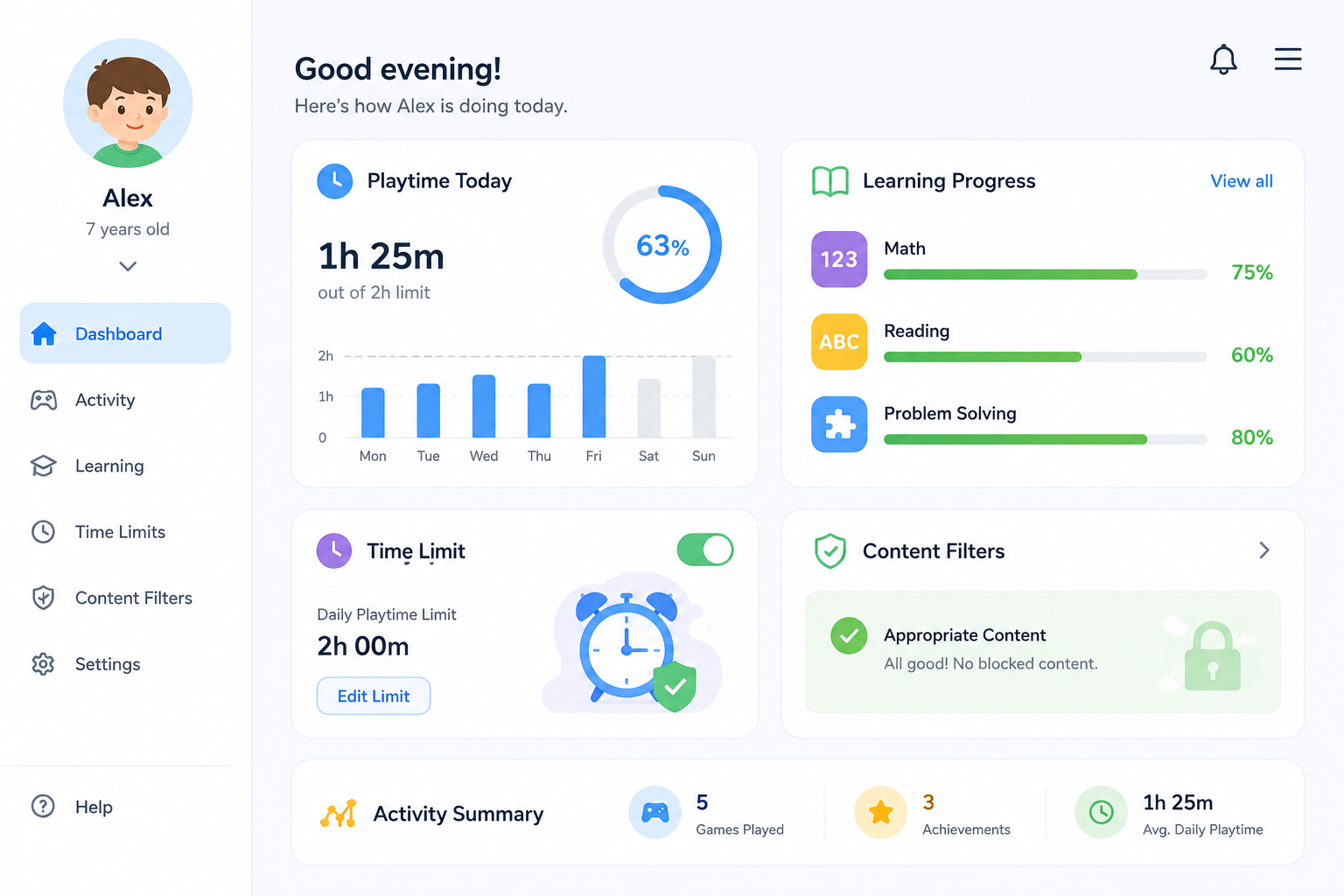
💡 Use Wolfoo's
parent dashboard
Wolfoo includes a parent
dashboard that makes the above easier: see what your child played and for how
long (with a 7-day chart), track their learning progress, view recent activity,
and switch on an optional daily time limit. Combined with games that end on
their own, it's simple to keep playtime in check — following your family's plan
rather than watching a clock.
👉
Open the Wolfoo parent dashboard
FAQ
How many hours is “enough”?
There's no magic number. Prioritize quality content, co-play, and protecting
sleep and movement first; the rest tends to balance itself (AAP, 2026).
What if my child melts down when
screens go off? Give a 5-minute warning, use content that ends on its own, and
stay calm and consistent — most meltdowns come from being cut off abruptly.
What about ads in the games?
Wolfoo does show ads (kept limited) like most free platforms; co-play the first
few times and use the time limit if needed.
The bottom line
Safe device use isn't about bans
— it's about a few gentle boundaries and the right tools. Start with one change
tonight: a screen curfew before bed, or switch on a daily limit in Wolfoo.
👉
Set a daily time limit in Wolfoo
Sources
• American Academy of Pediatrics
(2026). Digital Ecosystems, Children, and Adolescents. https://publications.aap.org/pediatrics/article/157/2/e2025075320/206129/Digital-Ecosystems-Children-and-Adolescents-Policy
• Toddler Screen Use Before Bed
and Sleep: A Randomized Clinical Trial (2024). PMC. https://pmc.ncbi.nlm.nih.gov/articles/PMC11581737/
• AAP — Media and Children &
Healthy Sleep (HealthyChildren.org). https://www.healthychildren.org/English/family-life/Media/Pages/default.aspx
• StudyFinds (2026). Screen Time
Tops Chores As America's #1 Family Fight. https://studyfinds.org/screen-time-tops-chores-americas-biggest-family-fight/