
Pretend Play: Why "Make-Believe" Nurtures Your Child's Imagination, Language and Emotions
When your child plays shopkeeper, doctor or superhero, it's more than just fun. Why does pretend play matter so much, and how can you join in?
Have you ever paused to watch your child sip from an empty cup, turn a cardboard box into a spaceship, or seriously "sell ice cream" to the whole family? Many parents quietly wonder: "Is all this make-believe actually good for anything, or is it just passing time?" It's a real and very common question. The good news: pretend play is far from pointless — it's one of the most important "jobs" of childhood.
What is pretend play, and why does it matter?
Pretend play (also called make-believe) is when children use their imagination to take on roles and invent situations that aren't real: being a doctor, cooking, running a shop, or putting a teddy bear to sleep. According to the American Academy of Pediatrics (AAP), this kind of play usually appears around ages 2–3 and reaches its peak during the preschool years, roughly ages 3–5.
What's fascinating is how closely pretend play is tied to language. When a child uses one object to stand for another — treating a spoon as a "microphone" or a blanket as a "superhero cape" — they are thinking symbolically. That's the foundation of language, because words are also symbols that stand for thoughts and things. It's no coincidence that children often say their first words around the same time they begin to pretend.
The skills your child practices while "just playing"
- Language and storytelling: children invent dialogue, sequence events, and practice putting thoughts into sentences.
- Emotional regulation: by acting out roles, children "rehearse" feelings like fear, joy and anger in a safe space. Research suggests children who pretend more tend to recognize and manage emotions better.
- Problem-solving: "What if the ice cream runs out?", "Where does the patient hurt?" — children learn to reason about hypothetical situations.
- Social skills: when playing with friends or parents, children negotiate roles, take turns, and follow the "rules" the group agrees on together.
How can parents join in?
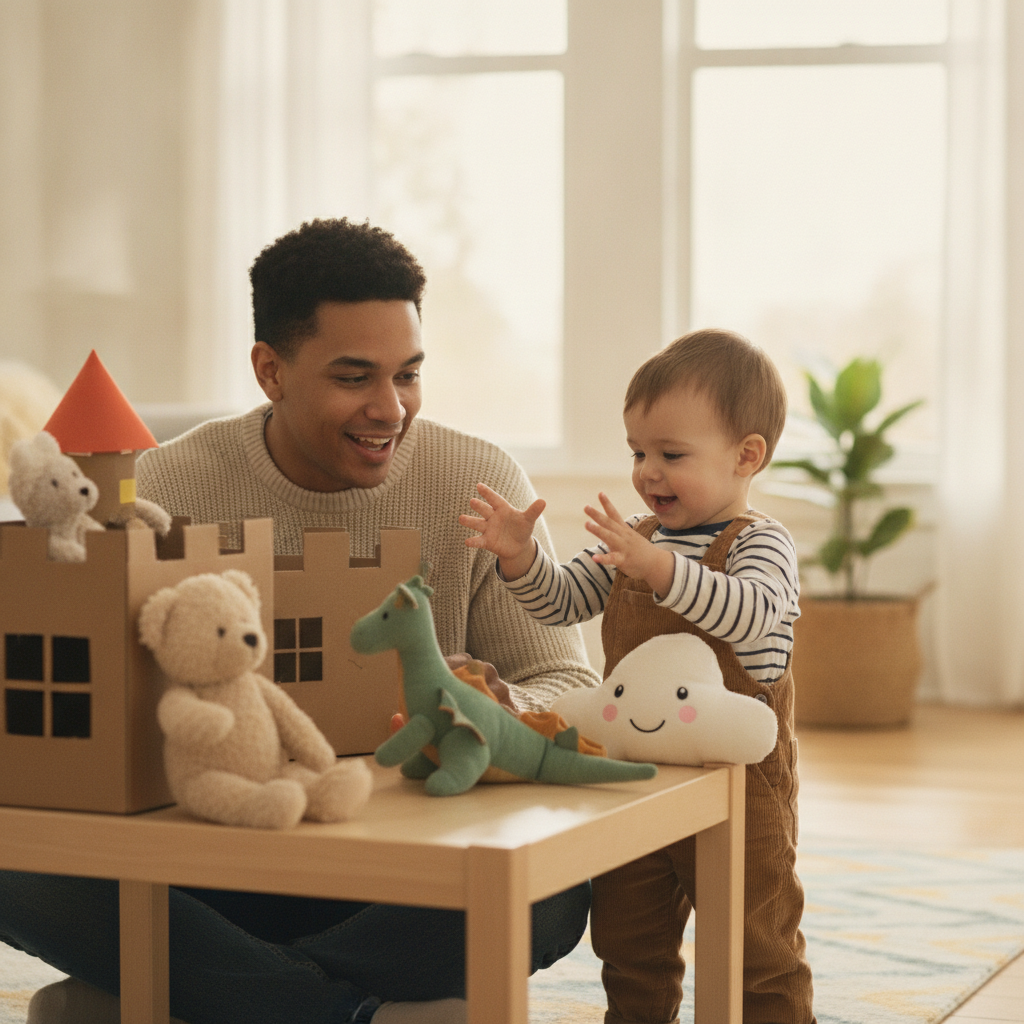
You don't need expensive toys or an elaborate script. A few simple ideas you can try today:
- Offer open-ended "props": cardboard boxes, scarves, old pots, a few stuffed animals. The simpler the toy, the more your child has to imagine.
- Play the "customer": let your child lead while you act as the shopper, the patient, or the audience. Ask open questions: "What's today's special at your shop?"
- Extend a story after reading: the AAP suggests reading with your child and then acting out the story in their own way.
- Resist correcting: if your child says the elephant can fly, just keep playing. "Illogical" imagination is exactly when creativity is working hardest.
What about pretend play on a screen?
Some role-play games on a screen can spark ideas for your child — for example, Wolfoo's Sweet Ice Cream Shop game lets children practice playing shopkeeper: taking orders, making ice cream, serving "customers." This can exercise following a sequence and remembering requests. But let's be honest: no screen game can replace real-world pretend play. The AAP emphasizes that playing with traditional toys, using hands and all the senses, tends to produce richer language than electronic toys. The best approach is to use a game as a short spark, then bring your child back to real make-believe — ideally with a friend or with you.
One note: Wolfoo's games are designed to be age-appropriate; any ads shown are age-appropriate and not personalized to children. It's still a good idea to sit with your child during early sessions to set time limits together.
Sample phrases to use while playing
- "Ooh, could I have a strawberry cone? How much is it, shopkeeper?"
- "Teddy looks sad — what could we do to cheer him up?"
- "What happens next in your story?"
Frequently asked questions
My 5-year-old still talks to toys — is that normal?
Completely normal. Ages 3–5 are the "high season" of pretend play. Chatting with a teddy bear or an imaginary friend is a sign of a healthy, growing imagination.
Does pretend play make children smarter at school?
Pretend play is linked to language, thinking and self-regulation — foundations that support learning. But it isn't a "magic" route to a smarter child; see it as a natural, precious part of childhood rather than a performance task.
My child only wants to play alone — should I step in?
Solo play is great for focus and creativity too. You can observe, occasionally "ask permission" to join, but there's no need to push. Let your child lead.
Sources
- American Academy of Pediatrics – HealthyChildren.org, "Pretend Play: Ways Children Can Exercise Their Imagination"
- American Academy of Pediatrics, "The Power of Play: A Pediatric Role in Enhancing Development in Young Children" (Pediatrics, 2018)
- Child Mind Institute, "The Power of Pretend Play for Children"