

A Screen-Smart End of Summer: Balancing Off-Screen Play and Learning Before School
You don't have to choose screen-free vs screens: build a screen-smart end of summer — mix off-screen play with short learning games and reset routines before school.
Mid-summer, many parents are searching “screen-free activities” and “no phone summer” — wanting less phone; at the same time “educational activities for kids” is surging too. The good news: you don’t have to choose between a total ban and unlimited play. A more sustainable path is screen-smart: mix off-screen play with a slice of quality screen time — and use the end of summer to reset routines before school.
Not “how many minutes” — but “what, and instead of what”
Recent guidance from the American Academy of Pediatrics (AAP) emphasizes content quality and context over a rigid minute count. A reasonable target for school-aged kids is about two hours of recreational screen time a day in summer — more on rainy days, less on nice ones. What matters is that screens don’t crowd out sleep, movement and free play.
3 principles for a screen-smart end of summer
1. Make off-screen and outdoor the default
Put outdoor play, pretend play and reading at the center of the day. Screens are a small part, not the hub.

2. Choose a “quality screen slice”
If there is screen time, let part of it be short play-based learning (15–20 minutes, with a parent nearby) instead of endless scrolling. For example Wolfoo Math for mental math, Wolfoo Word Search for vocabulary, or Wolfoo Memory Match for focus.
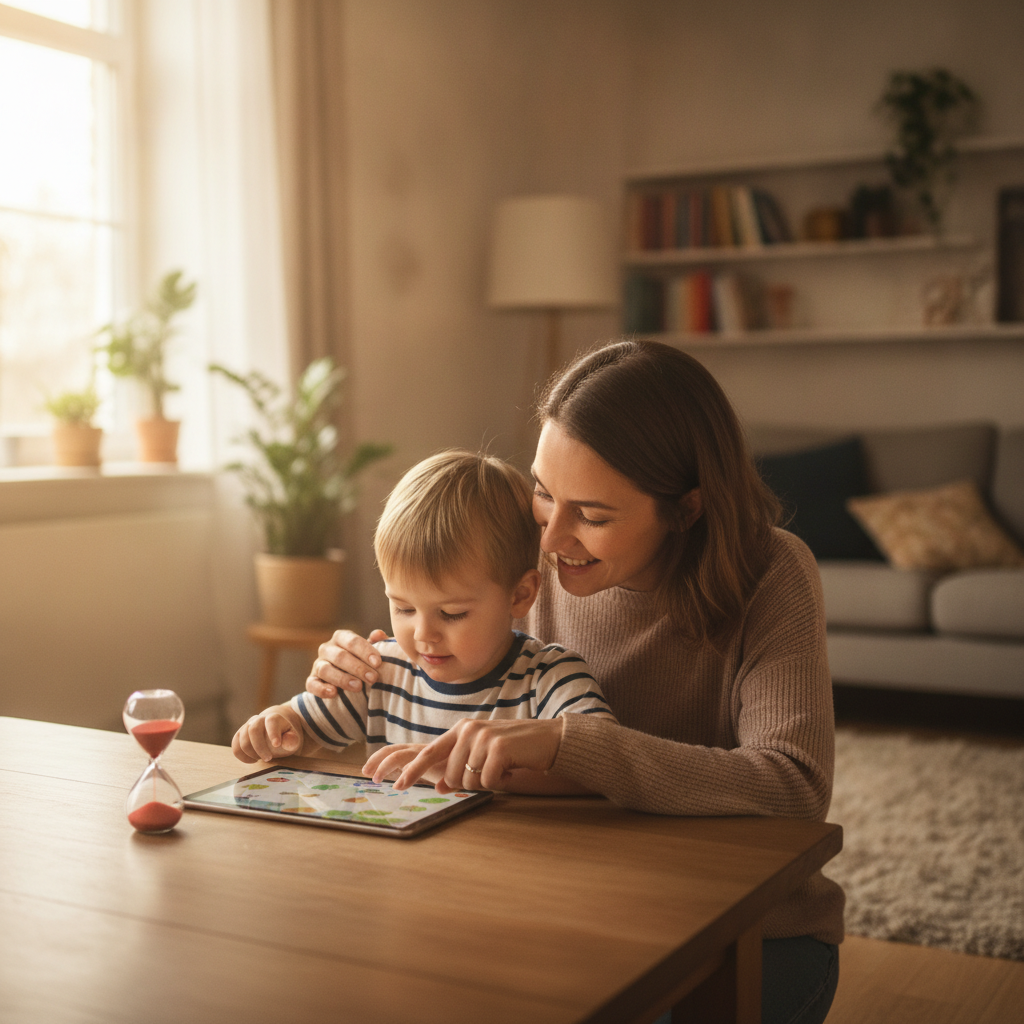
3. Reset routines before back-to-school
School is a few weeks away — now is the time to shift sleep/wake back toward the school schedule, set fixed screen windows, and keep device-free zones (meals, bedroom before sleep).
A sample screen-smart day
- Morning: movement / outdoors.
- Midday: reading or pretend play; 15–20 minutes of play-based learning.
- Afternoon: play with friends / family.
- Evening: device-free before bed.
A gentle run-up to school
For a child starting first grade, a little playful “warm-up” helps them ease into the rhythm — for example Wolfoo Pre-K Learning. Keep it light and fun.
Frequently asked questions
How much summer screen time is okay?
The AAP leans toward quality and co-engagement over a single number; about two hours of recreational time a day for school-aged kids is a reference point, as long as it doesn’t crowd out sleep and activity.
Are the games free and safe?
Yes. Free, no download, a child-directed environment with age-appropriate, non-personalized ads and parental controls.
Start small: pick one outdoor activity + 15 minutes of play-based learning like Wolfoo Math today.