

Clocks Fall Back Soon: How to Help Your Child's Sleep Adjust
When the clocks fall back, kids often wake up too early and fight bedtime. Here's a gentle way to help their sleep schedule catch up.
Short answer: when the days start getting darker earlier in late fall, your child's internal clock can genuinely get thrown off — they may feel sleepy earlier in the evening but then struggle to wake up while it's still dark outside. That's a normal response to light exposure, not your child being "difficult" or a sign you're handling bedtime wrong. With a few days of gradual adjustment, most kids ages 3 to 7 catch up on their own.
Here's a familiar scene: it's barely 5 p.m. and the sky is already dim, and your child is rubbing their eyes announcing "I'm sleepy" right after dinner — but the next morning, while it's still dark out, nothing gets them out of bed, and the whole house scrambles to make it out the door on time. You start wondering if they're coming down with something, or just having an off week.
Why does less evening daylight throw off my child's sleep?
A child's internal clock (like an adult's) is set mainly by sunlight, not by the clock on the wall. When it gets dark earlier in the evening, the brain picks up the "it's dark, time to wind down" signal sooner than usual — so your child gets sleepy earlier and can get cranky in the late afternoon. On the flip side, if mornings are still dark at wake-up time, their body hasn't gotten the "it's light, time to get up" cue yet, which makes waking up at the usual time noticeably harder. None of this is your child doing something wrong — it's how the body's clock responds to light.
Is it faster to just switch to the new schedule overnight?
It's tempting to just lock in the new bedtime right away, but that approach tends to backfire — your child will likely be more tired and more irritable for the first few days while their body plays catch-up. A gentler approach many pediatricians recommend is shifting bedtime and wake time gradually, about 10 to 15 minutes a day, instead of all at once.
Try saying: "Tonight we're going to bed just a tiny bit earlier, like a little practice round for our new schedule" — framing the shift as something small and playful instead of an abrupt new rule.
How do I make mornings easier when it's still dark out?
Morning light plays a key role in switching off the brain's sleepy signal. If your child's room is still dark at wake-up time, turn the lights on as soon as you wake them, open the curtains if it's getting light outside, or get them into natural daylight as soon as possible after they're up — even a few minutes on the porch or in the yard can do more than a warm breakfast alone.
A concrete tip: keep breakfast time and the out-the-door time fixed, even on mornings your child wakes up a few minutes later than usual — anchoring the rest of the day's routine tends to help the body catch up faster than adjusting bedtime alone.
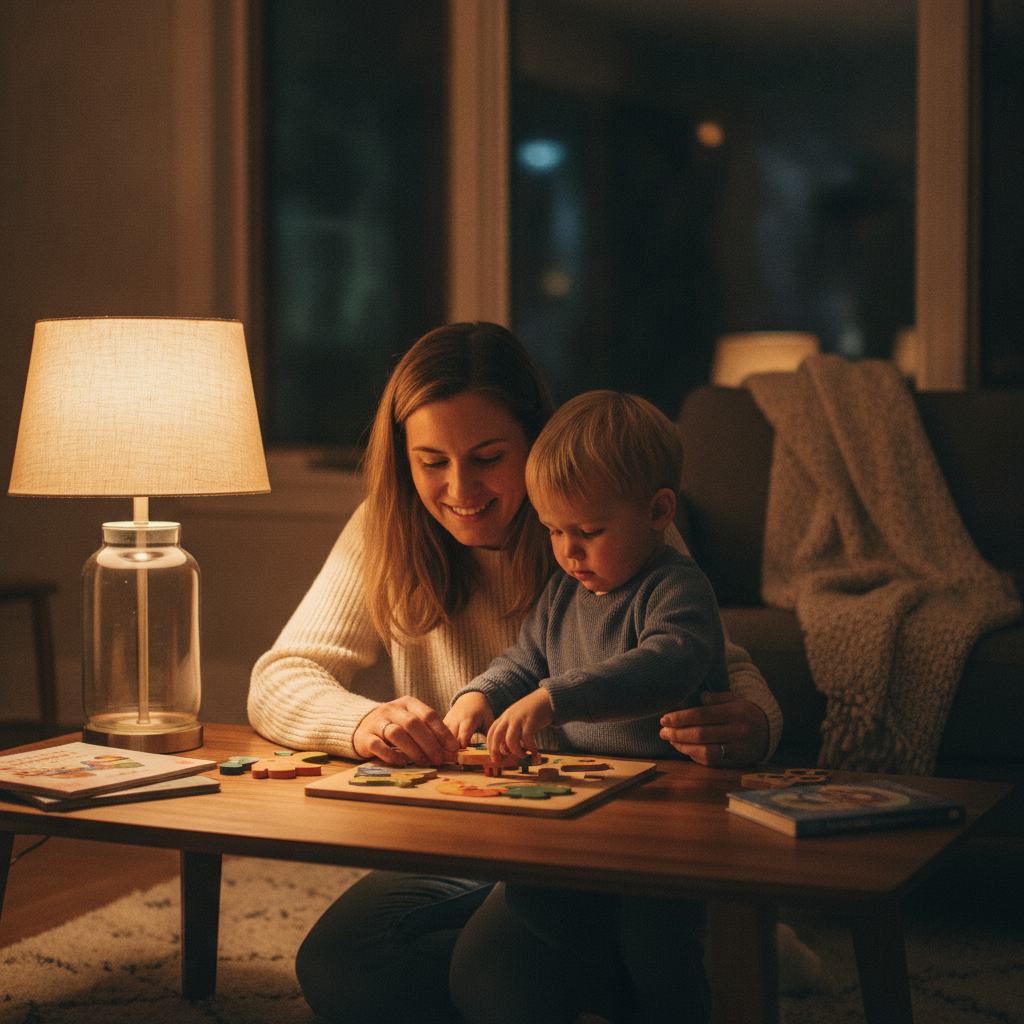
In the evening, after dinner, a calm, quiet, no-winner activity is a better cue that the day is wrapping up than anything high-energy that can wake your child back up right when you need them winding down.
A few calm games for the new evening window
Wolfoo Blossom Garden (ages 3-8) has no win-or-lose pressure and a slow pace, good for a few settled minutes before bed. Wolfoo Tangram (ages 3-8) lets your child piece together shapes at their own speed, building patience without anyone rushing them. Wolfoo Happy Cup (ages 3-8) is a short, easy-to-finish challenge that ends the evening on "I did that" instead of leftover excitement.
So how worried should I actually be?
Being honest here: none of the strategies above, including the games, will get your child fully adjusted overnight. Most kids need about 3 to 7 days for their body to catch up, and the first few days can still bring more crankiness than usual even when you're doing everything right. This is the body needing time, not a sign you're getting it wrong.
When it's worth asking a professional
Most seasonal sleep hiccups like this are temporary. A few signs are worth raising with a pediatrician instead of waiting it out:
- Trouble falling asleep or waking up that continues for more than 2 to 3 weeks with no improvement despite a gradual adjustment.
- Noticeable tiredness throughout the day that affects school or play, not just the mornings.
- Snoring, irregular breathing during sleep, or frequent night waking — these point to a separate sleep issue, not the seasonal light change.
- A teacher independently noticing unusual tiredness or trouble focusing.
Frequently asked questions
How long does it take a child to adjust when daylight saving time ends?
Usually about 3 to 7 days, depending on the child. Shifting bedtime gradually, around 10-15 minutes a day, tends to help kids catch up faster than an abrupt change.
Should I let my child nap longer to make up for lost sleep?
A much longer nap than usual can make it harder to fall asleep that night. If your child is overtired, it's usually better to keep naps close to normal and make up the difference with a slightly earlier bedtime instead.
My child is waking up earlier than usual in the morning — is that from the time change?
Possibly. If their room is still dark at wake-up time, their body can get woken by other cues (street light, noise) instead of a natural light signal. Blackout curtains or a dim night light transition can help.
Does evening screen time make this worse?
It can play a role — blue light from screens in the evening can also delay the brain's sleepy signal, so this is a good stretch to prioritize calm, low-stimulation activities before bed.
If winding down screens in the evening is already a nightly struggle at your house, Does a "5-Minute Warning" Really Stop Screen Time Tantrums? has a few concrete approaches. And for more ideas on what to do instead of extra screen time in the evening, What to Do Instead of More Screen Time has more suggestions.
Sources
- General pediatric guidance (from children's health systems such as Memorial Care and UVA Health) on gradually shifting a child's sleep schedule around seasonal time changes.
- Research on the role of morning light exposure in regulating children's circadian rhythm and sleep onset (as reported via PsyPost, summarizing children's sleep science research).
This article is general guidance for parents and isn't a substitute for medical advice from a pediatrician, especially if sleep trouble continues for more than a few weeks or comes with other unusual symptoms.