
Which Wolfoo Games Suit Your Child? A Detailed Guide by Age (3–7)
A 3-year-old and a 7-year-old need very different games. This detailed guide helps you choose Wolfoo games by age (3–7) — what's developing, which games fit, and how to spot the right difficulty.
The same game looks very
different to a 3-year-old and a 7-year-old — and they need different
challenges. Choosing the right game for your child's age keeps it fun and helps
them grow at the right pace; the wrong choice can leave them bored or
frustrated.
Wolfoo has 50+ games across
many genres, so parents sometimes wonder where to start. Here's a guide by
stage, ages 3–7: what your child is developing, which Wolfoo games fit, what to
watch for, and how to adjust the difficulty.
Key takeaways
•
There's no “one game for every age” — choose for your
child's stage.
•
Age 3: simple and colorful; 4–5: counting, shapes,
observation; 6–7: logic, words, strategy.
•
The right difficulty keeps kids confident — not bored,
not frustrated.
•
Games are only part of it — pair them with movement and
co-play.
•
Watching how your child plays also tells you where they
are developmentally.
Why age matters
Children develop in stages: fine
motor skills, language, memory and logical thinking emerge over time — which is
why organizations like the CDC publish age-based “developmental milestones” for
parents (CDC, Learn the Signs. Act Early.). The American Academy of Pediatrics
also notes that play matched to development builds focus, memory and
problem-solving (Yogman et al., 2018).
The practical takeaway: too-easy
games bore kids and they quit fast; too-hard games frustrate them. The “sweet
spot” is when your child has to try a little but can still succeed — that's
where learning is strongest.
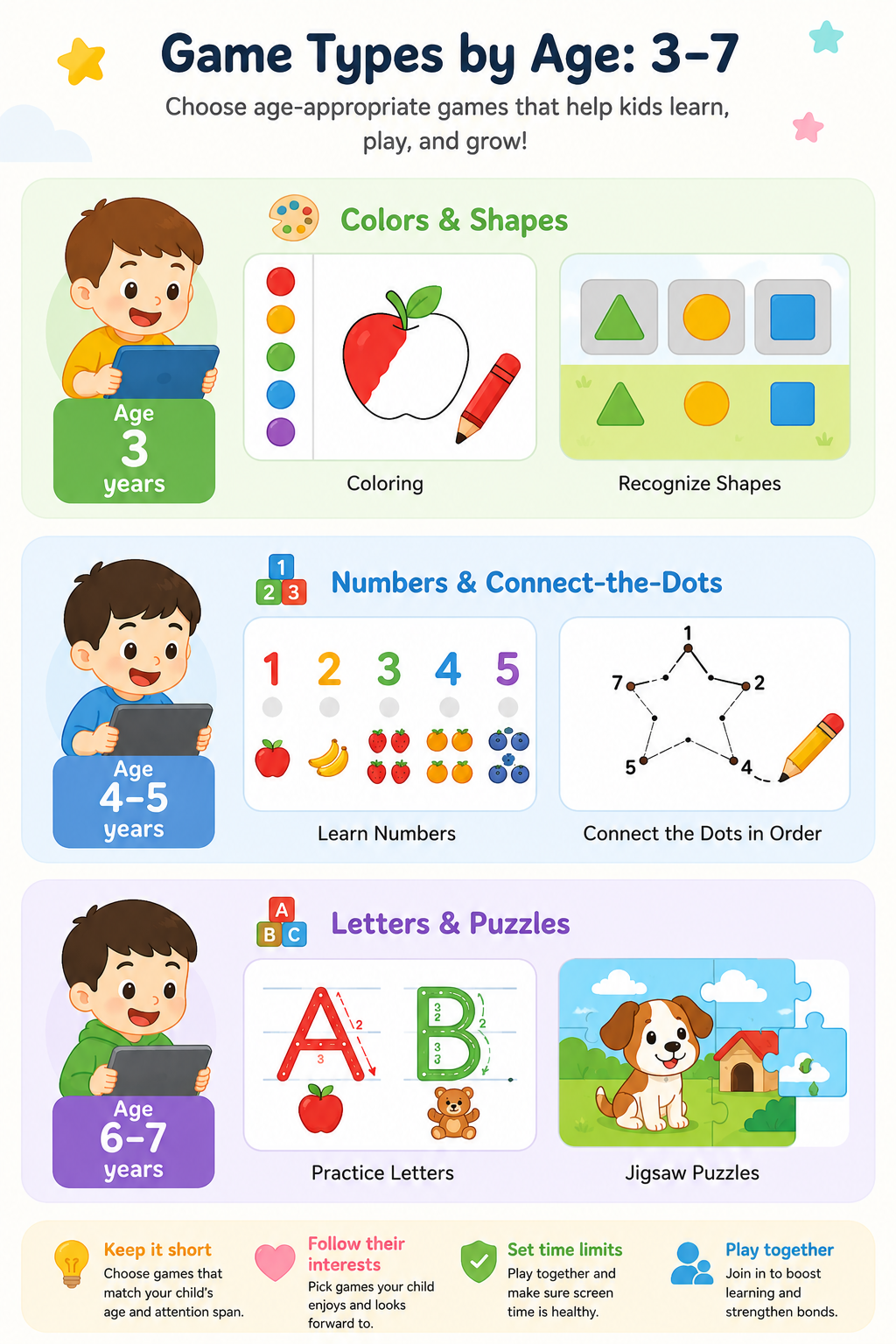
Age 3 — simple &
colorful
At this age, children learn by
touching, looking, and repeating; attention spans are short and fine motor
skills are still developing. Choose games with few rules, big images, lots of
color, and instant feedback.
On Wolfoo, try the Colors games
and an easy level of Wolfoo Memory. Play together, say colors and objects out
loud, and celebrate each small win. Watch for: can they recognize colors and
repeat simple actions?
Ages 4–5 — counting, shapes
& observation
Now kids love counting,
recognizing shapes, noticing details, and they start to grasp rules and take
turns. Good fits: Wolfoo Connect-the-Dots (numbers, shapes) and Wolfoo
Spot-the-Difference (observation, focus).
Tip: ask “what looks different?”
and “let's count how many” so they play and talk at once — reinforcing language
too. Watch for: how long they focus and whether they persist in searching.
Ages 6–7 — logic, words
& strategy
Your child is ready for thinking
challenges: they're beginning to read, plan, and persist. Try Wolfoo Word
Search (vocabulary, letter recognition), the Quiz games, and the Strategy /
Escape categories to build planning and problem-solving.
Tip: encourage “think before you
tap” and trying again after a mistake — this is a prime age for building
persistence. Watch for: how they handle losing and whether they try new
approaches.
How to tell if a game is too
easy or too hard
•
Too easy: instant wins, plays for seconds then quits,
no interest.
•
Too hard: frustration, wanting to quit, or constantly
asking you to do it.
•
Just right: focused, try-fail-try-again, and joy at
succeeding.
If your child seems bored or
frustrated, just switch genre or difficulty on Wolfoo — every child moves at
their own pace.
💡 Try it now on
Wolfoo Game
Wolfoo organizes games by genre
(Colors, Learning, Quiz, Adventure, Strategy…), so it's easy to choose by your
child's age. Start with one age-appropriate game, play a few rounds together,
then step up the difficulty as they get comfortable. The parent dashboard even
shows what they play most, helping you choose what's next.
From game to real life
Pair a game with a real-world
activity using the same skill for deeper learning and more screen-free time: a
3-year-old sorts objects by color; a 4–5-year-old counts toys or finds shapes
around the house; a 6–7-year-old does a paper word search or a logic puzzle.

FAQ
My child keeps wanting older
kids' games — what do I do? That's normal. You can let them try alongside you
(co-play), but keep most of their time in age-appropriate games so they don't
get discouraged.
When should I increase the
difficulty? When they've mastered a game and start finding it “too easy.” Step
up one level at a time and watch how they respond.
Do I need to force “educational”
games? No. Interest is the best motivator — let them choose within
age-appropriate options, and play along when you can.
The bottom line
The secret isn't “less or more”
screen time — it's playing the right thing. Choose age-appropriate games,
observe your child, play together, and raise the challenge gradually — and
they'll have fun while growing every day.
👉
Pick Wolfoo games for your child's age
Sources
• Yogman, M., et al. (2018). The
Power of Play. Pediatrics — American Academy of Pediatrics. https://publications.aap.org/pediatrics/article/142/3/e20182058/38649/The-Power-of-Play-A-Pediatric-Role-in-Enhancing
• CDC — Developmental Milestones
(Learn the Signs. Act Early.). https://www.cdc.gov/ncbddd/actearly/milestones/index.html
• AAP — Media and Children
(HealthyChildren.org). https://www.healthychildren.org/English/family-life/Media/Pages/default.aspx