

How to Pick a Halloween Costume Your 3-7-Year-Old Will Actually Want to Wear
Short answer: the best Halloween costume for a young child isn't the cutest one — it's the one they're comfortable in, easy to spot in the dark, and got to help choose.
Short answer: the best Halloween costume for a 3-7-year-old isn't the cutest one online — it's one that checks three boxes: your child can wear it comfortably all evening, it's easy to spot in the dark, and they got some say in picking it.
Here's a familiar scene: you order an adorable costume online, the product photos look perfect. At home, your child tries it on and within five minutes is squirming to take it off — maybe the fabric itches, the mask makes it hard to breathe, or they wanted to be a "dinosaur," not the princess you'd pictured. On Halloween night, a gorgeous costume your child refuses to wear doesn't do anyone any good.
Why a "cute" costume can still make kids miserable all night
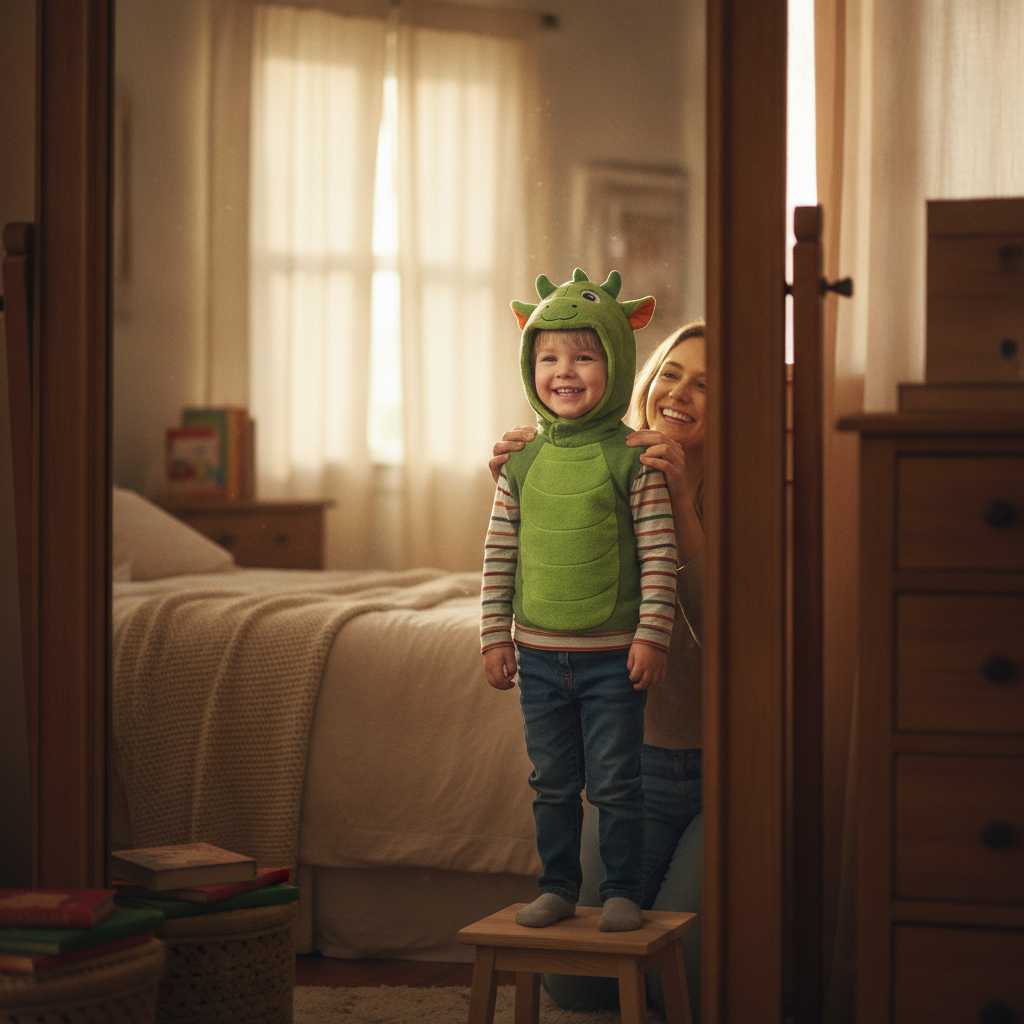
Most store-bought Halloween costumes are designed to look good in photos, not to be worn for hours. Stiff synthetic fabric, tight seams at the wrists and ankles, and masks that restrict breathing or vision are all common triggers for discomfort and meltdowns in 3-7-year-olds, who are often still quite sensitive to how things feel against their skin. One simple fix: have your child do a full trial run at home — walking around, sitting down, raising their arms — a few days before Halloween, instead of the first wear being trick-or-treat night itself.
Visibility in the dark matters more than you'd think
According to Dr. Stephanie Ruest, a pediatric emergency medicine physician at Hasbro Children's (via NBC10/WJAR), her biggest worry on Halloween night isn't anything spooky — it's pedestrian safety. With so many kids out at once, dark costumes and masks make it harder for them to see what's going on around them, and drivers aren't always paying close attention either. Dr. Ruest recommends adding flashing lights or reflective strips to your child's costume or candy bag so they're easier to spot in the dark — a small, easy fix that matters far more than how "cute" the costume looks.
Let them pick their own character, even if it's not your taste
Choosing who to "become" is part of what makes pretend play fun — a type of play the American Academy of Pediatrics (AAP) recognizes as important for language, emotional development, and imagination. A child who wants to be a "garbage truck driver" or a "T. rex" instead of a sparkly princess isn't doing anything wrong — they're just choosing what genuinely excites them. Offering a short list of two or three options (an animal, a job, an imaginary creature) usually works better than a fully open-ended "be whatever you want."
Being honest: you can't always get both cute and perfect
Sometimes keeping your child comfortable and visible means accepting a costume that looks a little less polished than the catalog photo — no full-face mask, softer fabric, a clip-on light that doesn't quite match the theme. That's a reasonable trade-off, not a sign you didn't try hard enough. A costume your child can wear comfortably all evening and that's easy to spot in the dark is always a better outcome than a perfect-looking one they beg to take off halfway through.
What if your child is genuinely scared of masks or costumes?
Some kids don't just find masks uncomfortable — they're genuinely frightened by them, even their own reflection in a mirror. If that's your child, there's no need to force a masked or face-painted costume just because "everyone else is doing it." Why Is My Child Scared of Costumes and Masks? digs into why this is pretty common at this age, and how to make it easier — including the option to skip the costume part of Halloween entirely this year.
A dress-up game to try looks out before committing
If your child is still torn between costume ideas, letting them try a few styles on-screen first can help — no money spent on a costume that doesn't work out, no itchy fabric, no pressure to decide right away. Lucy's Fashion Dress-Up (ages 3-7) lets your child mix and match outfit styles to see what they actually like. Lucy's Makeup & Dress-Up (ages 5-10) lets them try a few different character looks before picking one for real.
When it's worth asking someone
Mild fussing over new fabric or an unfamiliar mask is normal. But if your child reacts strongly to any costume or dress-up clothing, not just at Halloween, or if sensitivity to fabric and clothing tags is affecting daily life beyond one holiday, that's worth bringing up with a pediatrician or an occupational therapist who specializes in sensory development.
FAQ
Is it worth paying more for a higher-quality costume?
Not necessarily. A simple costume in soft fabric that your child actually enjoys wearing usually "wins" over an expensive one they're uncomfortable in all night.
Should masks be avoided entirely?
Not entirely, but prioritize ones that don't block vision and can be removed quickly if your child feels overwhelmed or wants to take it off mid-evening.
What if my child changes their mind right before Halloween?
Pretty normal at this age. Having a simple backup option made from things you already have at home takes the pressure off if that happens.
Will a clip-on light bother my child if they wear it too long?
Take it off as soon as you're back home — it's only needed while you're outside in the dark, not for the rest of the evening indoors.
Sources
- Dr. Stephanie Ruest, pediatric emergency medicine physician at Hasbro Children's — interviewed by NBC10/WJAR, "Halloween safety tips for parents" (published October 15, 2026).
- American Academy of Pediatrics (AAP) — general guidance on the role of pretend play in early childhood development.
This article is general information and isn't a substitute for professional medical or developmental advice for your child's specific situation.