

How to Get Your Child to Play Independently
Five to fifteen minutes is normal at three. The hard part isn't the toys — it's the twenty minutes you have to sit on your hands.
Short answer: if you want your child to play alone for longer, the first thing to change isn't the toys — it's that you stop making suggestions. Every time we tell a child what to do next, we take one repetition away from them.
Before anything else, a number to bring expectations back to earth: a three-year-old typically plays alone for 5-15 minutes, a five-year-old for 20-30 on a settled day. If your child seems to have "no attention span," you may just be measuring against a standard that doesn't exist.
Why we interrupt
It isn't impatience. Sitting beside a child doing something slightly wrong, slightly slowly, or slightly boringly is genuinely uncomfortable — and a suggestion relieves that in about two seconds.
There's a quieter reason too: when they need us, we know we matter. Naming that helps more than any technique.
A four-week ladder
Don't jump straight to "go and play by yourself for twenty minutes." It usually fails on the first try, and then the failure becomes proof that your child "just won't play alone."
- Week 1 — beside them, silent. Sit within arm's reach, no questions, no ideas. Two or three minutes is a success.
- Week 2 — beside them, busy. Same spot, something in your hands. Your child seeing you occupied is the actual signal.
- Week 3 — across the room. Answer the first bid for attention properly; respond to later ones warmly but without stopping what you're doing.
- Week 4 — in and out. Leave for a minute, return without ceremony. Returning calmly is what makes leaving feel safe.
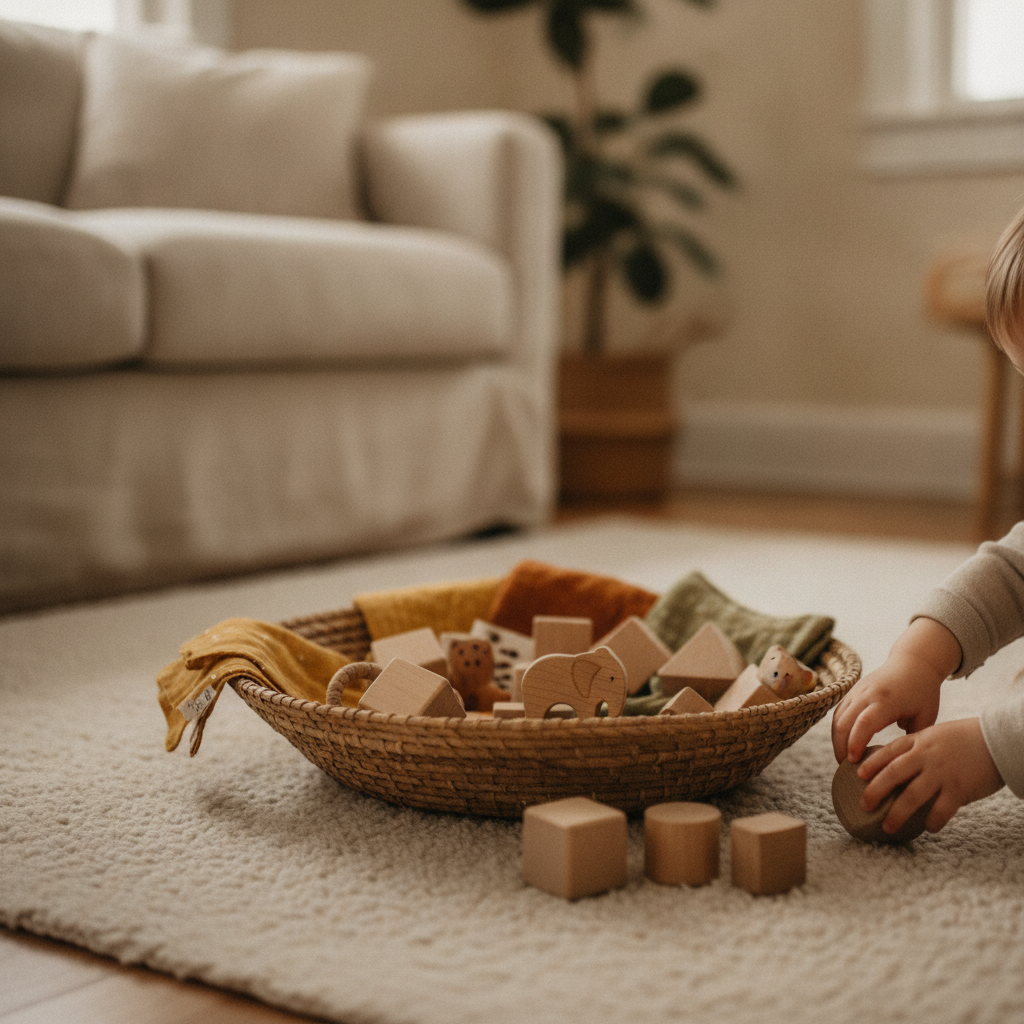
Fewer toys out, changed more often
A floor with forty things on it isn't a rich environment — it's a decision your child can't make. Store two-thirds out of sight, put out one basket, swap it weekly. The same blocks come back interesting.
Favour materials with no finish line: blocks, small figures, playdough, a scooping tray. Anything with one correct answer ends the moment your child gets it right.
The boredom gap is a good sign
When you stop supplying ideas, there's a stretch — a few minutes, sometimes a few days — where your child follows you around announcing there's nothing to do. That isn't the approach failing. It's the gap where their own ideas have room to appear, and if we fill it fast enough, they never have to make one.
Warm and brief works best: "I know. It's a boring bit. Something will come to you." Usually within four minutes.
If you want an option on a screen
The American Academy of Pediatrics, in The Power of Play, describes child-led play as a main route through which young children learn to solve problems. The operative words are child-led — and that applies on a screen too.
If you need something for a ten-minute stretch your child can handle alone, pick games that need no adult sitting alongside explaining, run at a slow pace, and don't run a clock. A few free browser options, no download needed:
- Wolfoo Tangram — shape fitting, self-correcting, no time limit.
- Wolfoo Water Sort Puzzle — colour sorting at your child's own pace.
- Wolfoo Blossom Garden — slow-paced, suited to younger children.
- Wolfoo Geometry Connect — one continuous line, retry as often as you like.
One honest caveat: a screen is independent, but it doesn't replace an empty rug. A game supplies the ideas; the rug asks your child to make their own. Keep both in the week, and don't count one as the other. Parents can set limits on the parental controls page.
If you would rather the screen slot became a rhythm than a nightly negotiation, the Play Streak page marks one game a day as a streak — essentially a sticker chart for the tablet. And if you just want more options, the full game list is free to play with no streak involved.
Frequently asked questions
My child only plays alone if I'm in the room. Is that a problem?
Entirely normal at this age. Being near you is what makes going deep feel safe. The distance grows later, and grows faster if you don't force it.
How much independent play should we aim for daily?
No target is worth chasing. One decent stretch most days does far more than a scheduled hour that ends in tears.
My child wrecks what they built and gets upset. Should I step in?
Step in for the feeling, not the tower. Sit down, name the frustration, resist rebuilding it. Rebuilding solves our discomfort, not theirs.
What about siblings?
Playing together doesn't replace playing alone — they're different skills. With two children, try two separate corners of the same room rather than separate rooms.
Sources
- American Academy of Pediatrics — The Power of Play: A Pediatric Role in Enhancing Development in Young Children.