

Screens Before Bedtime: Why Turning Them Off Early Helps Your Child Sleep (Ages 3–7)
Does your child struggle to settle after a tablet or phone? Here's why screens close to bedtime keep kids alert — and how a gentle wind-down hour helps children 3–7 sleep better.
You just switched off the tablet, but your child is still wide awake — bright eyes, one more request for water, one more story. Many parents know this exact scene, and wonder: "Are screens making it harder for my child to sleep?" It's a fair question, and the good news is that a few small tweaks to the evening routine can make bedtime noticeably easier.
Why do screens close to bedtime keep kids awake?
There are two main reasons, and both are about biology — not your child being "difficult."
The first is light. The light from screens can slow down the body's release of melatonin, the hormone that signals "it's time to feel sleepy." When melatonin rises late, your child's brain still thinks it's daytime and isn't ready for sleep.
The second is arousal. An action-packed game or an exciting video can leave a child more alert, with a faster heart rate and a mind still buzzing from what they watched. The American Academy of Pediatrics (AAP) recommends turning off all screens at least 60 minutes before bedtime and keeping phones, tablets, and TVs out of the bedroom, especially at night.
What is a "wind-down hour" and how do you start?
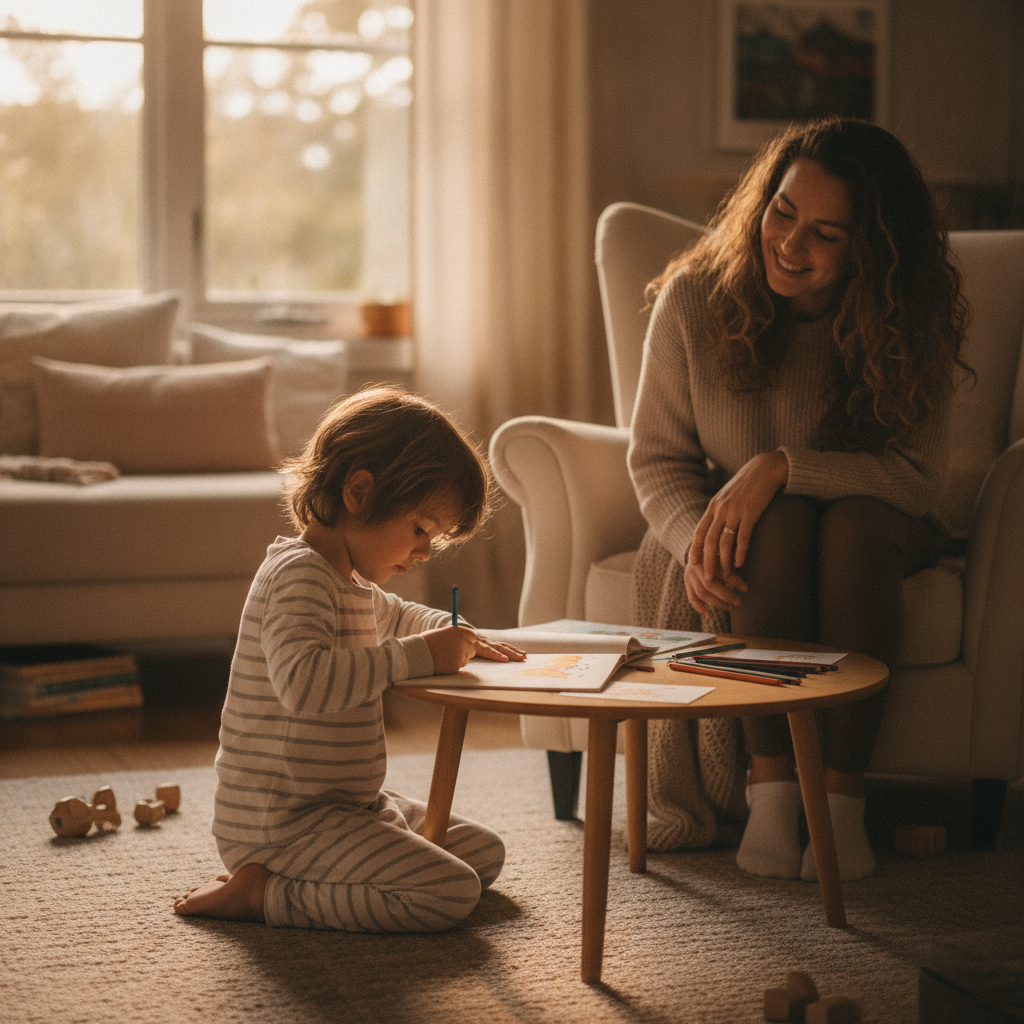
The wind-down is the last 30–60 minutes before bed, when the whole home deliberately slows down: softer lights, quieter voices, gentler activities. Young children rely heavily on cues from their environment to know that sleep is coming, so a routine that repeats every night helps them predict what's next and cooperate more easily.
A few easy ideas:
- Set a fixed "screens off" moment. For example: "When the clock says 8, we say goodnight to the tablet."
- Swap in calm activities: reading a picture book, colouring on paper, doing a wooden puzzle, sharing "three good things about today."
- Keep the sequence the same: bath — teeth — story — lights out. The repetition itself is reassuring.
- Charge devices outside the bedroom so your child's room is a place for sleep, not play.
If your child loves games, how do you fit them in?
Loving games isn't a problem — what matters is when and what. Instead of letting play land right before bed, move it earlier in the day and save the evening for calm activities. If your child still wants a little screen time in the early evening, choose gentle games with no stressful timers and no rush — rather than fast, high-action ones.
For example, Color Learning with Wolfoo (a good fit for ages 3–7) has a slow pace focused on recognising colours and colouring in, so children practise looking closely without getting over-stimulated. For a child who likes shapes, Wolfoo Tangram is a quiet option that builds spatial thinking at your child's own pace. These are free to play in the browser with no download and are designed to be safe under COPPA; any advertising is age-appropriate and not personalised to children.
To be honest: no game can replace sleep, and no game can "cure" trouble falling asleep. Games should be a small, fun part of the day; in the evening, what your child needs most is calm and closeness with you.
A few sample lines to move from screen to sleep gently
- "One last turn, then we'll put it away together. I'll count with you."
- "It's wind-down time now. Which book would you like tonight?"
- "The tablet is going to sleep too — we'll play again tomorrow. Now it's our turn to snuggle under a warm blanket."
A calm voice and a familiar routine usually work far better than rushing. If tonight didn't go smoothly, that's okay — habits take time to form, and every evening is a fresh start.
Frequently asked questions
How long before bed should screens be off?
The AAP suggests at least 60 minutes before bedtime. If that's hard at first, start with 30 minutes and stretch it out — the key is being consistent every night.
If my child watches calm, soothing content, will they sleep better?
Gentle content is less stimulating than exciting content, but screen light can still affect melatonin. So whatever the content, it's best to stop screens before bed and switch to a screen-free activity.
Should the tablet stay in my child's bedroom?
Ideally not. The AAP recommends keeping screens out of the bedroom, especially at night, so your child's room stays a space for sleep.
Sources
- American Academy of Pediatrics — HealthyChildren.org, "Healthy Sleep Habits: How Many Hours Does Your Child Need?"
- American Academy of Pediatrics — HealthyChildren.org, "Helping Kids Thrive in a Digital World: AAP Policy Explained"
- AAP Center of Excellence on Social Media and Youth Mental Health — "Screen Time Affecting Sleep"
This article is general guidance for parents and does not replace medical advice. If your child regularly struggles to sleep, talk with your pediatrician.