

The 8 Types of Intelligence, Ages 3–6: Eight Kinds of Play Worth Putting in Your Child's Week
Eight groups of activity to widen your child's play week — with an everyday idea and a game for each. A list for sorting activities, not a test for labelling children.
If you have ever watched your child play the same thing for the tenth day running and wondered whether they are missing out on something else — you are not alone. The useful answer usually is not to assess your child. It is to widen what they get offered.
This article uses eight familiar groups of activity — based on the categories psychologist Howard Gardner set out in Frames of Mind (1983) — as a reminder of variety, a way to make your child's week a little wider.
One important note before you read on. We use the eight groups below to categorise activities, not children. Please do not use this article to conclude that your child "is a visual learner" or "is a kinaesthetic learner." Gardner's framework is a useful way to organise activities, but researchers have not found evidence that these are separate abilities in the brain — a 2023 review in Frontiers in Psychology argues the theory is best treated as a neuromyth. What is well supported is far simpler: varied play beats narrow play.
What are the 8 types of intelligence?
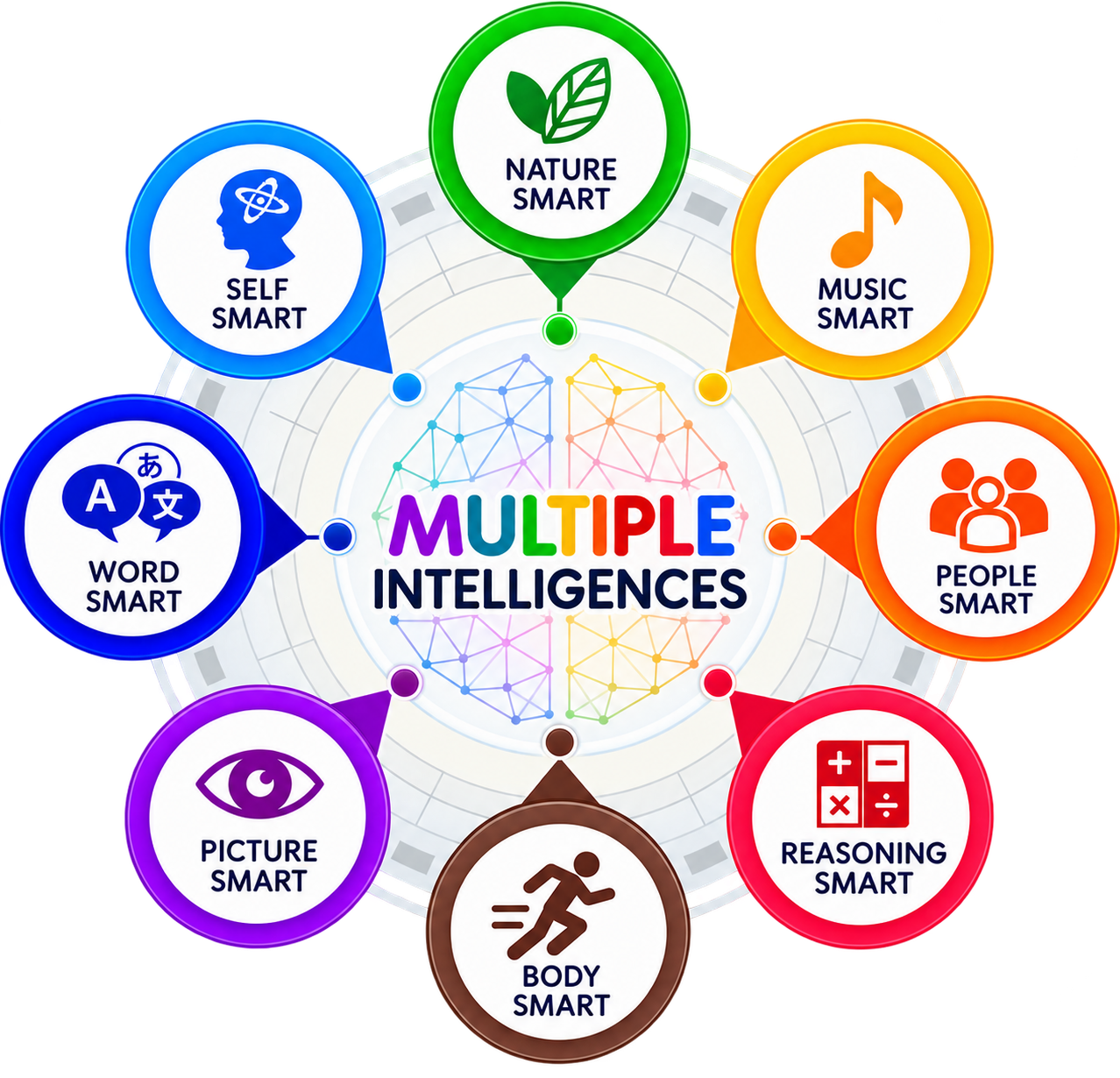
Gardner described eight groups of ability. In practice they are not independent — factor analyses show they correlate substantially — so treat this as eight kinds of activity worth putting into your child's week, rather than eight boxes to sort children into:
- Word Smart (Linguistic): loves stories, questions, songs and new words.
- Number/Logic Smart (Logical-mathematical): enjoys sorting, patterns, counting and "why" questions.
- Picture Smart (Spatial): loves puzzles, drawing, building and finding their way around.
- Body Smart (Bodily-kinesthetic): learns by moving, running, and using their hands.
- Music Smart (Musical): notices rhythm, hums tunes, taps along to beats.
- People Smart (Interpersonal): reads friends' feelings, loves group play and sharing.
- Self Smart (Intrapersonal): knows their own likes and feelings, enjoys focused solo play.
- Nature Smart (Naturalist): is fascinated by animals, plants, weather and sorting the natural world.
Multiple intelligences vs learning styles: one thing to get right
Multiple intelligences is not the same as "learning styles." A common myth is that you should teach a child only through their strongest channel. Many educators now caution against that. The healthier reading — and the one supported by Gardner himself — is to use your child's strengths as a bridge while still offering the full range. A music-smart child can learn to count through songs; a body-smart child can act out a story instead of only sitting to read. Variety is the goal.
To be clear about the evidence: the idea of teaching to a child's "learning style" has repeatedly failed to hold up when tested in real classrooms. So use this list to choose activities — not to choose a special way of teaching your child.
Everyday activities and games to develop each intelligence
You do not need special equipment. Everyday moments matter most — and short, purposeful play can add a fun layer. Here is a simple pairing of each group with an activity and one game idea you can try together:
- Word Smart: read aloud and let them finish the sentence. Try a spelling game to play with letters and sounds.
- Number/Logic Smart: count stairs, sort socks by color. A gentle counting game turns numbers into play.
- Picture Smart: build with blocks and do puzzles. A tangram puzzle or memory matching game builds visual thinking.
- Body Smart: dance, balance, and hands-on play. A reflex-based balloon game pairs eyes and hands.
- Music Smart: clap rhythms and sing daily routines. A simple sequence game lets them remember and repeat a pattern.
- People Smart: take turns, name feelings, and play together — a cooperative team-up game is nice to play side by side.
- Self Smart: let them choose and express. Open-ended play like a coloring game lets them make their own choices.
- Nature Smart: watch birds, water a plant, sort leaves. An animal-themed caterpillar game or a spot-the-difference game feeds the noticing habit.

"But is screen time okay?"
It is a fair question. Leading guidance from bodies like the American Academy of Pediatrics (AAP) points not to zero screens, but to purposeful, high-quality use with a caregiver nearby. In January 2026 the AAP moved away from fixed hourly limits toward a contextual view: what the content is, what it is replacing, and whether anyone is engaging with the child about it. The AAP's Power of Play work also reminds us that unstructured, playful interaction is one of the most powerful things for a young child's development.
How Wolfoo Games can help
Wolfoo Games offers free browser-based mini-games for young children, grouped by the kind of thinking they gently practice — letters, numbers, puzzles, memory, rhythm and creativity. They run in a browser with no download and no account needed; the site is COPPA-compliant, serves non-personalised advertising and has a parental controls page. Use them as one small, playful layer in a varied day — a handful of minutes to spark a skill, then back to blocks, books and outdoor play.
FAQ
What are the 8 types of intelligence?
Word, Number/Logic, Picture, Body, Music, People, Self and Nature smart — the eight intelligences described by Howard Gardner in 1983 (he later noted a possible ninth, "existential").
At what age should I start varying my child's play?
Ages 3–6 are a rich window, but there is no deadline. The aim is simply to keep offering varied experiences across the years rather than boxing a child into one "type."
Can games really support my child's development?
Well-chosen, short games can help practice specific skills — like patience, color recognition or letter sounds — especially when an adult plays along. They work best as a complement to hands-on, real-world play, not a replacement.
Want to try a different kind of play tonight? The simplest approach is to rotate the kind of play each day, about ten minutes at a time. We have grouped the games into these eight kinds of play on the Play Streak page, or see the 8-day plan if you would rather follow a schedule. You can also browse every game by age.
References
- Howard Gardner, Frames of Mind: The Theory of Multiple Intelligences (1983).
- Waterhouse, L. (2023). Why multiple intelligences theory is a neuromyth. Frontiers in Psychology.
- American Academy of Pediatrics (AAP) — The Power of Play and digital media guidance for families (January 2026), healthychildren.org.