

Playing With Your Child But Still Checking Your Phone — Do They Notice?
A few seconds on your phone during playtime, and your child reacts strongly? Researchers call it "technoference" — and here's a gentler way to start.
Short answer: Yes, there's a good chance your child notices — at least in that moment. Researchers who study this call it "technoference": the small, everyday interruptions tech causes during time with your child. A handful of studies link frequent technoference to some behavior changes in kids. But this is an observed association, not proof that glancing at your phone causes harm, and it definitely doesn't mean one quick check ruins anything.
Here's a familiar scene: you sit down on the floor to build blocks with your child, and your phone buzzes in your pocket. You think, "just ten seconds," check the message, type a quick reply. You look up and your child has abandoned the half-built tower and is tugging your sleeve: "Look, look! Mom, look!" — said three times before you actually look up.
Why does a few seconds on your phone get such a big reaction?
Young children, especially ages 3 to 7, read a parent's "presence" mostly through eye contact and how quickly you respond — not through words. For an adult, glancing away for a few seconds barely registers. For a child mid-play, it's a clear, sudden change: their playmate just disappeared without warning. Calling your name repeatedly or tugging at you is usually an attempt to pull your attention back, not a tantrum.
Is there actual research measuring this?
Yes. Researcher Brandon McDaniel and colleagues, including Jenny Radesky, surveyed 170 U.S. couples with young children, published in Child Development in 2017. They found that parents who had more trouble managing their own device use also reported more technoference during time with their child — and more technoference was linked to children showing more difficult behavior (irritability, trouble focusing), even after accounting for parental stress. A separate observational study by Hiniker and colleagues (2015) watched parents at a playground and found about 35% spent at least one in every five minutes looking at their phone instead of their child.
Both are correlational studies with modest samples (170 families, one playground), and the researchers themselves say it's unclear whether parents reach for their phones more because a child is already being difficult, or whether the interruptions make things harder — most likely some of both.
Does a parent's own phone use cause a child's screen use?
A different line of research, a 2026 systematic review in BMJ Public Health, pooled 39 studies covering nearly 33,000 children under six across 17 countries. It found that a parent's own screen time was the strongest predictor of a child's screen use, and that more parental stress and burnout was linked to more smartphone use in young children. Worth being precise here: this review relies almost entirely on parents' self-reported surveys, not device tracking, and the authors flagged only 3 of the 39 studies as meeting all their quality benchmarks — so treat this as a reasonable signal, not a rule that applies to every family.
So is picking up my phone around my child actually harmful?
No. Here's the honest part: no study shows that occasional phone checks cause harm. Children don't need 100% of your attention at all times — the research above is about repeated patterns and difficulty controlling device use, not answering one work message. Worrying too much about this doesn't help either. A more realistic goal is a few short stretches of genuinely undistracted play each day, not a phone-free day.
A concrete tip: before you sit down to play, set your phone face-down somewhere just out of easy reach, and switch to vibrate instead of a lit-up screen — a bright screen pulls your eyes far more than a quiet buzz in your pocket.
A phrase to try when you really do need to answer: "I need to answer this for one minute — keep building that part, and I'll come back and see how far you got" — this gives your child a warning instead of a sudden disappearance, and names exactly when you'll return.
A few games that make it easier to put the phone down for 10–15 minutes
Wolfoo Spot the Difference (ages 4–12) has you both looking at the same picture, so it's immediately obvious if one of you drifts off to a screen instead. Wolfoo Sequence (ages 4–12) runs in short turns of just a few seconds each — enough to practice giving your full attention in small bursts without committing a whole evening. Wolfoo Tangram (ages 3–8) has no timer and no winner, good for sitting side by side piecing shapes together without anyone needing to perform enthusiasm.
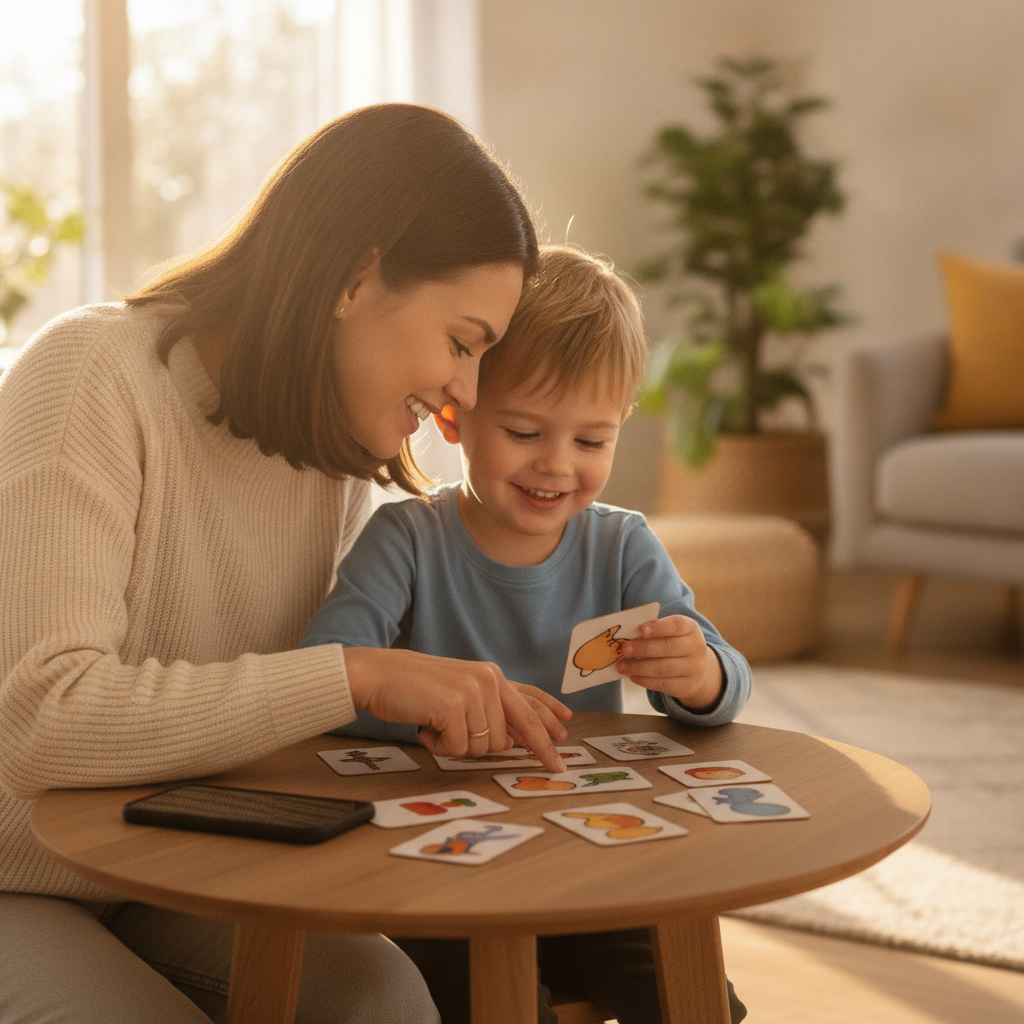
Being honest: these games don't fix distraction on their own — they just give you a structured, easier-to-start window than fully open-ended free play. If you're still glancing at your phone while playing, your child notices the same way they would with any toy. The actual "putting the phone down" part still has to come from you; the game just makes starting easier. If you've ever frozen up not knowing how to play with your child, Don't Know How to Play With Your Child? Start Here has more gentle starting points. And on days you're simply too tired, 5 Low-Energy Ways to Connect Anyway can help.
When it's worth asking a professional, instead of just reassuring yourself
- Your child repeatedly calls your name, tugs at you, or reacts with clear distress every time you pick up your phone — persisting for weeks, not just once or twice.
- You've genuinely tried to cut back and still can't put your phone down, and it's causing you real worry or guilt.
- A teacher or another caregiver has independently noticed your child seems unusually clingy or has trouble separating from you.
In these cases, talking with a teacher or pediatrician will tell you more than guessing at home.
Frequently asked questions
What does "technoference" mean?
It's the term researchers use for the small, everyday interruptions that phones and other devices cause during time parents spend with their children — like glancing at a phone mid-play.
Is it harmful to check my phone sometimes while playing with my child?
There's no evidence that occasional checks cause harm. The research is about frequent, hard-to-control patterns, not answering one message.
Does playing a game together on a tablet count as "putting the phone down"?
Yes, as long as you're actually watching and responding to your child during play — as opposed to handing over the device and doing something else beside them.
How do I remember to put my phone down without missing something important?
Try a short timer (10–15 minutes) for play, switch to vibrate instead of a lit screen, and keep your phone just out of easy reach — you'll still hear an urgent call without the constant temptation to glance.
One note for peace of mind: Wolfoo's browser games are free to play, need no install, are designed with child safety in line with COPPA, and show age-appropriate, non-personalized ads. The games here are just an easier window to start in — they don't replace the attention you actually give your child.
Sources
- McDaniel, B. T. & Radesky, J. (2017), Child Development — a survey of 170 U.S. couples on technoference during time with their children.
- Hiniker, A. et al. (2015) — an observational study of parent phone use at a playground.
- de Azevedo, L. B. et al. (2026), BMJ Public Health — a systematic review of 39 studies covering nearly 33,000 children under six across 17 countries, on factors linked to children's mobile device use.
- American Academy of Pediatrics (AAP) — "The Power of Play" clinical report, on how interactive play supports parent-child bonding.
This article draws on correlational, observational research, not proof of cause and effect, and isn't a substitute for professional guidance from a teacher or pediatrician.