

Is It Okay to Let Your Toddler Use a Tablet on a Long Flight or Car Ride?
Short answer: screens on a long trip aren't the problem. Timing, prep, and having non-screen backups ready are what actually make the ride smoother.
Short answer: there's nothing wrong with letting your toddler use a tablet or phone on a long flight or car ride. According to the American Academy of Pediatrics (AAP), there's no research suggesting that using screens to occupy kids on long car, bus, train, or plane rides causes any harm. What actually makes the difference between a smooth trip and a meltdown-filled one is something else entirely: when you hand over the device, whether you've prepped ahead of time, and whether you've got other options ready too.
Here's a familiar scene before a holiday trip: the flights are booked, the bags are packed, you've double-checked the portable charger is in your carry-on. Twenty minutes into the flight or drive, your child is already squirming, asking "are we there yet," and sliding toward a meltdown. You hand over the phone almost on reflex — relieved, but also a little guilty, wondering if you just caved too fast.
Does screen time on a long trip actually hurt kids?
According to the AAP's Center of Excellence on Social Media and Youth Mental Health, there's no evidence that using media to occupy children on long car, bus, train, or plane rides causes harm. The AAP does note that screen use can crowd out time for parent-child interaction, reading, play, and sleep — but on a flight specifically, that crowded-out time is usually small, since most of it would have gone to sitting, snacking, or napping anyway. Their advice: think of screens as a parenting resource for this kind of situation, not something to avoid at all costs.
When to hand over the device — and when to wait it out
Dr. Jenny Radesky, MD, FAAP, who writes for the AAP, suggests a simple but useful habit: don't reach for the screen the moment your child starts to fuss — wait a bit and try something else first. When you do need it, pre-select and download age-appropriate content before you leave home, rather than searching mid-flight with spotty wifi. Starting and pausing content yourself, instead of letting it autoplay endlessly, also makes it easier for your child to transition away from it later. Before you pause for a bathroom break or a snack, give a heads-up: "We'll finish this part, then take a little break."
Screen-free activities that make the hours go faster
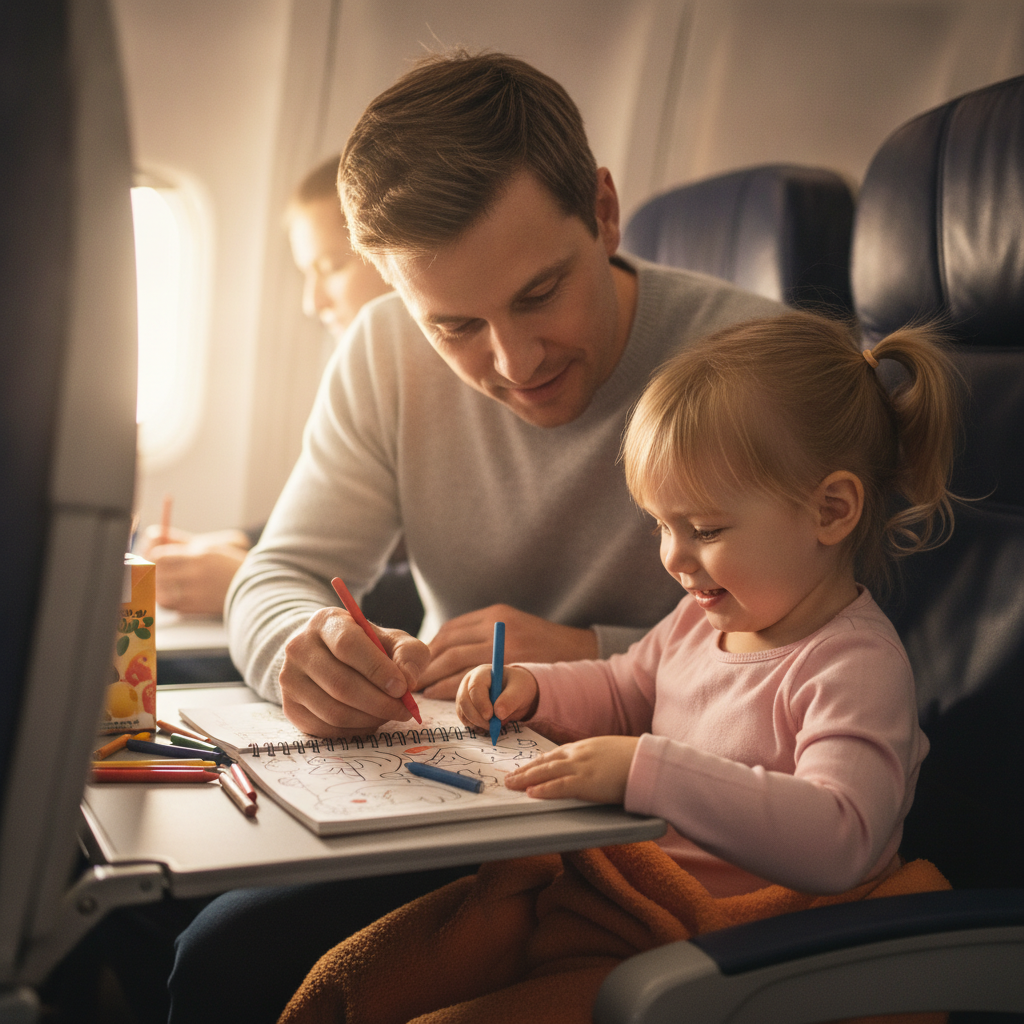
The AAP recommends packing a few non-screen options instead of relying on one device for the whole trip: a couple of small books, a mess-free doodle pad, a small magnetic puzzle, or a finger puppet. Their reasoning is simple — when kids have a few different things to choose from, switching away from the screen (or to it) tends to go more smoothly. Letting your child help with the journey itself also gives them something to do: pulling their own small bag, holding the boarding pass, spotting the gate number. Bringing a familiar pillow or blanket from home can help too, giving them a small sense of home in an unfamiliar space.
Where this advice stops applying
Worth being honest here: "screens on a trip are fine" applies to a specific, time-limited situation — travel entertainment — not to screen use in general. The AAP separately notes that routinely using screens as the only way to calm a child down whenever they're upset or frustrated is linked to more emotional difficulties later on. That's a different context from a few hours on a flight, and the two shouldn't be lumped together. In other words: a tablet on a plane is a tool for one specific situation, not a default way to handle every hard moment at home.
A few calm games with natural stopping points worth packing
If your child already plays on a phone or tablet, picking games with short rounds and a clear end point is easier to wind down than an endless autoplay video. Wolfoo Color Learning (ages 3-7) runs in short rounds — once a picture is colored in, it's a natural place to stop. Wolfoo Supermarket Sort (ages 3-9) is a short sorting game that builds observation and organizing skills, one quick round at a time. Wolfoo Tangram (ages 3-8) has your child match shapes to a pattern — similar to the physical tangram puzzles parents often pack for trips, just fitting in a phone instead. All three run straight in the browser with no download or login required, and carry age-appropriate, non-personalized ads.
When it's worth asking someone
Some fussing or discomfort over a few hours of travel is completely normal at this age. But a few signs are worth bringing up with a pediatrician or child psychologist rather than managing alone every time:
- A clear, lasting fear of flying or riding in cars, beyond ordinary restlessness.
- Your child takes several days after a trip to settle back into their normal sleep and routine.
- Noticeable separation anxiety around travel that doesn't ease up over time.
- Your child will only stay calm with a screen on, and reacts unusually strongly when offered anything else.
If ending screen time without a meltdown is already a struggle at home, Does a "5-Minute Warning" Really Stop Screen Time Tantrums? has some concrete tactics. Looking for more screen-free activity ideas beyond travel days? AAP Just Dropped the Screen Time Number: What to Do Instead digs into that. And if you're running low on energy but still want to connect during a long trip, Too Tired to Play With Your Kid? 5 Low-Energy Ways to Connect Anyway can help.
FAQ
What about kids under 2 — should they get screen time on a long trip?
The AAP's general guidance is still to avoid screens (other than video chat) under 18-24 months. For an unavoidable long trip, lean as heavily as possible on screen-free activities first, and treat a screen as a last resort for short stretches only.
Should I download content ahead of time?
Yes. Downloading shows, music, or games at home, on reliable wifi, saves you from scrambling mid-trip with spotty connectivity, and avoids surprise ads or recommended content showing up unexpectedly.
Should I worry my child will get "hooked" after using screens more than usual on a trip?
A few extra hours in an unusual situation isn't the same as an everyday habit. What matters more is your child's regular routine once you're back, not one isolated trip.
Are offline games a safer choice on a flight?
They're more practical since they don't depend on spotty wifi. For actual safety, prioritize games with no account required and no stranger chat feature, whether or not they need an internet connection.
Sources
- American Academy of Pediatrics (AAP) — Center of Excellence on Social Media and Youth Mental Health, Q&A Portal, "Travel and Screen Time" (updated August 28, 2024).
- HealthyChildren.org (AAP) — Jenny Radesky, MD, FAAP, "Is screen time OK for young children on a long flight to help keep them entertained?" (updated July 23, 2025).
This article is general information and isn't a substitute for professional medical or psychological advice for your child's specific situation.