
Does Sugar Really Make Kids Hyper After Halloween?
Your child bounces off the walls after trick-or-treating? Research says sugar isn't the real cause — and what's actually behind it.
Short answer: no, sugar (Halloween candy) is almost certainly not why your child is bouncing off the walls after trick-or-treating. Multiple studies, including a well-known meta-analysis in JAMA, found no evidence that sugar changes children's behavior or ability to focus. What actually revs kids up on Halloween night is excitement, bright lights, noise, and a later-than-usual bedtime — not the candy they just ate.
Here's a familiar scene: your child gets home from trick-or-treating and starts running laps around the living room, bouncing on the couch, talking a mile a minute, dumping the whole candy bucket on the floor to count it over and over. You sigh: "Must be all that sugar." But the real story is a bit more interesting than that.
What does the science actually say about "sugar highs"?
A 1995 meta-analysis published in JAMA, reviewing 23 trials across 16 separate studies, concluded that sugar (mainly sucrose) does not affect children's behavior or cognitive performance. A separate study in the New England Journal of Medicine, comparing typical children with children their own parents described as "sugar-sensitive," also found no significant difference across the tested diets.
So why does this belief stick around? A 1994 study in the Journal of Abnormal Child Psychology offers a clue: when mothers were (incorrectly) told their sons had just had a sugary drink, they rated the boys as noticeably more hyperactive — even though the drink was actually sugar-free. In other words, a parent's own expectation can shape what hyperactivity they "see," regardless of what's actually in a child's system.
So why does my child still act wired after Halloween?
A few real things are happening, and none of them are sugar: your child just had an evening packed with stimulation — costumes, neighbors' flashing porch lights, meeting lots of strangers in disguise, more walking than usual, and most importantly, a bedtime that's slipped well past normal. Add it all up and you get an overstimulated child whose behavior looks a lot like "hyper," but the real driver is a nervous system processing a flood of novelty, not a blood sugar spike. The same bounce-off-the-walls energy shows up after a crowded birthday party for the same reason — the evening itself is the stimulant, not the snack table.
So should I still worry about the candy?
Being honest here: the fact that sugar doesn't cause an immediate hyperactive spike doesn't mean unlimited candy is fine. Eating a lot of sugar still affects dental health and long-term eating habits — that's a real reason to set a limit, just not the "to stop a sugar high" reason. The two things are separate: limiting candy for health reasons is reasonable; blaming that night's hyper behavior on the candy itself isn't supported by current research.
A reasonable way to help your child wind down
Since the real cause is overstimulation rather than sugar, the most effective approach is helping your child's nervous system come down gradually, not cutting off candy abruptly.
Try saying: "We had such a fun night! Let's sit down and play something calm to get ready for bed" — naming the fun first, then shifting the pace, instead of demanding an instant stop.
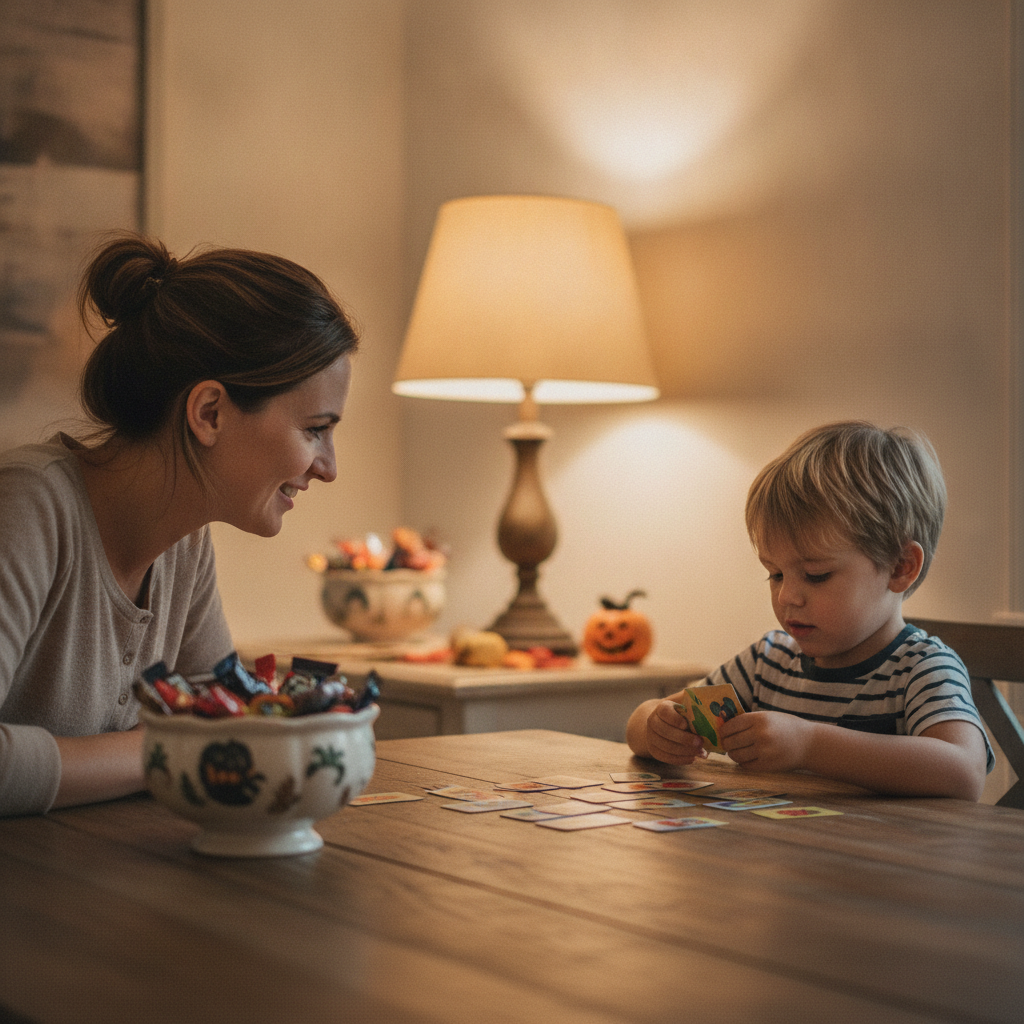
A concrete tip: dim bright lights, turn down the noise, and set aside 10–15 minutes for a slow-paced, no-winner activity before bed — this is where a slow-paced game can genuinely help, not to tire your child out further, but as a gentle bridge between an exciting evening and sleep.
A few slow-paced games to help your child wind down before bed
Wolfoo Blossom Garden (ages 3–8) has no win-or-lose pressure and a slow pace, good for a few settled minutes after a loud evening. Wolfoo Memory Match (ages 4–8) asks your child to focus gently on matching pairs, a natural way to bring scattered attention back down. Wolfoo Happy Cup (ages 3–8) is a short, easy-to-finish challenge that ends the evening on a quiet sense of accomplishment instead of leftover excitement.
When it's worth asking a professional
Most post-Halloween hyperactivity is temporary and settles within a day or two. A few signs are worth raising with a pediatrician rather than waiting it out:
- Hyperactive, unfocused behavior that continues for several weeks, not just around a single high-stimulation event.
- A clear physical reaction (rash, stomachache, vomiting) after a specific type of candy — that can be a sign of a real food allergy, not a "sugar high."
- Trouble sleeping or persistent irritability that lasts well beyond a night or two after Halloween.
- A teacher independently noticing similar behavior outside of holidays too.
Frequently asked questions
Does sugar really have no effect on kids' behavior at all?
Large studies haven't found evidence that sugar changes behavior or focus for most children. A small number of children may be more sensitive, but that isn't the general rule.
Then why does my child always get wild after birthday party treats?
Birthday parties, Halloween, and other celebrations all come with excitement, noise, a crowd of friends, and a disrupted routine — these affect behavior far more than the treat itself.
So I don't need to limit my child's candy anymore?
Still worth limiting — for dental health and long-term eating habits, just not to prevent a "hyper" episode.
My child can't sleep on Halloween night — is that the sugar?
More likely it's the later bedtime and leftover excitement, not the sugar. A gentle wind-down routine before bed usually helps more than waiting for a "sugar crash."
If you're still working on healthy, self-limiting screen habits, What to do instead of more screen time has a few more ideas. And if your child got scared by something on Halloween night, My Kid Got Scared by a Halloween Horror Ad can help.
Sources
- Meta-analysis published in JAMA (1995) — reviewing 23 trials across 16 studies, concluding sugar does not affect children's behavior or cognition.
- New England Journal of Medicine — a study comparing typical children and children described as "sugar-sensitive," finding no significant difference across tested diets.
- Journal of Abnormal Child Psychology (1994) — a study showing that a parent's own expectation (believing a child had just had sugar) shaped how they rated the child's behavior, even when the child received a placebo.
This article is general guidance for parents and isn't a substitute for medical advice from a pediatrician, especially if you suspect a real food allergy or an actual attention disorder.