

Ending Screen Time Without Meltdowns: Gentle Transitions When Playtime Is Over
Turning off the screen is often the hardest moment of the day. Here is why kids react so strongly, and six ways to make the transition gentler.
You say "time's up" — and seconds later come the tears, the shouting, or a small body flung onto the floor. If this sounds familiar, you are far from alone. Turning off the screen is one of the most stressful moments of the day for many families with children aged 3-7. The good news: this reaction is not a sign of a "bad" child. It is your child's brain doing exactly what a young brain does. Once you understand that, the moment gets easier to handle — and gentler for everyone.
Why do kids melt down when screen time ends?
When a child is playing or watching something engaging, the brain releases dopamine, a chemical tied to good feelings. When the screen switches off suddenly, that dopamine drops just as suddenly, and the jump from high stimulation to none can leave a child feeling let down, unsettled, even angry. Allina Health points to this as a key reason tantrums erupt right after a device goes off.
On top of that, children aged 3-7 are still learning to cope with disappointment. HealthyChildren.org (the parent site of the American Academy of Pediatrics, or AAP) reminds us that a tantrum shows a child is finding it impossible in the moment to manage big feelings — not that they are deliberately defying you. Seeing it this way helps you stand beside your child rather than treat the moment as a battle.
6 ways to make the transition gentler
1. Agree on the rules BEFORE the screen goes on
Common Sense Media advises letting kids know there is a clear start and end from the very beginning. Before you hand over the device, keep it simple: "You can play until the timer rings, then we'll turn it off and set the table together." When your child knows what's coming, ending feels less like a sudden brake.
2. Let your child set the timer
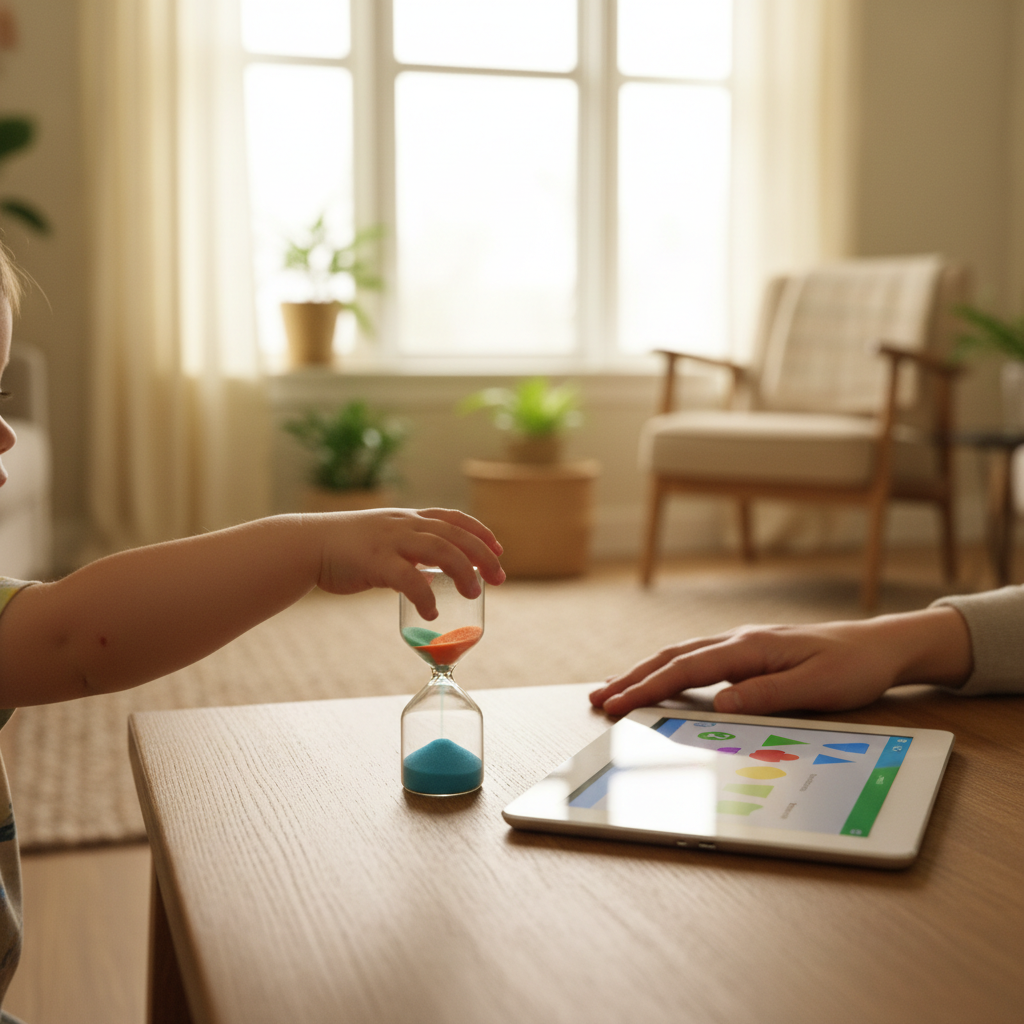
HealthyChildren.org suggests letting children set a timer themselves. A sand timer or a small kitchen bell helps a child feel in control, and it's an early lesson in self-regulation. When the timer is the one announcing "time's up," you're no longer the only "bad guy."
3. Choose content with a clear stopping point
Videos that autoplay from one episode to the next give the brain nowhere to stop. Favor activities with short, self-contained rounds — finishing one round is a natural endpoint. For example, Wolfoo Memory Match is split into short card-matching rounds, so it's easy to agree on "finish this round, then we stop" — a clear, honest promise you can keep. The game is free to play, age-appropriate, and includes parental controls, but to be honest: no game or trick erases tantrums completely — they only make the ending feel less abrupt.
4. Give a two-minute warning — then let them turn it off
For many kids, a gentle "two more minutes" helps them prepare. Then let your child press the off button. Common Sense Media finds that turning off the device themselves gives kids a sense of control, and many feel proud that "I did it."
5. When the meltdown has started: few words, steady ground
Mid-tantrum, a child can't process reasoning. HealthyChildren.org advises against explaining the rules in that moment — just keep it short, kind, and hold your ground: "I know this is hard. It's time to put the tablet away." You can hug your child or sit nearby, but the boundary stays in place.
6. Praise a good transition
When your child turns the device off and moves on without a fuss, acknowledge it right away: "Thanks for turning it off and coming to build blocks with me!" Specific praise helps a child understand which behavior is welcome, making it easier to repeat next time.
A calm space for your child
HealthyChildren.org suggests setting up a "calm-down spot" — a small, quiet place in the home where your child feels safe. If your child starts to rage when screen time ends, you can invite them to sit there until they feel better. This isn't a punishment; it's a place to practice settling themselves.
And keep the AAP guidance in mind: for ages 2-5, aim for about one hour of high-quality content per day, with boundaries and balance so kids still get sleep, active play, and family time. The AAP's updated recommendations also stress that what matters isn't only "how many screen minutes," but the family time around them. If you'd like a playful way to talk about knowing when to stop, Wolfoo Don't Overplay can spark that conversation together.
Frequently asked questions
Does a two-minute warning always work?
Not for every child. Common Sense Media notes that some kids transition better without a warning, because the warning becomes a cue to "get ready to argue." Try both approaches over a few days and keep whichever fits your child.
My child melts down hard every time — should I drop screens entirely?
End-of-screen tantrums are very common at this age and usually ease as children grow and rules stay consistent. You don't have to cut screens out completely — what matters is a clear boundary held calmly. If your child has unusually intense or prolonged outbursts, talk with your pediatrician for personalized advice.
Should I use screens as a reward or punishment?
Many experts suggest avoiding turning screens into a "big reward," since that makes them more coveted and harder to give up. Treat screen time as a normal part of the day with clear timing, like any other activity.
References
- HealthyChildren.org (AAP) — Screen Time & Temper Tantrums: Helpful Tips for Parents
- Common Sense Media — How do I put a stop to screen time without causing a meltdown?
- American Academy of Pediatrics (AAP) — screen time guidelines for young children
- Allina Health — Understanding & Managing Post-Screen-Time Anger in Kids