

How Spot-the-Difference Games Build Your Child's Focus and Pre-Reading Skills
Why spot-the-difference games quietly build your child's attention, observation and pre-reading skills — plus how to play together for more meaning.
Your child might sit for whole minutes scanning two nearly identical pictures to find what's different — and that's good news. Behind the simple "spot-the-difference" game is a quiet workout for observation, focus, and visual discrimination — all foundations your child needs before learning to read. Here's why it matters, and how to turn it into quality time together.
What skills does spot-the-difference build?
To find a difference, your child has to compare tiny details across two images — that's visual discrimination. It's surprisingly important: children need to tell very similar shapes apart (like "b" and "d", or "6" and "9") before they can read smoothly. At the same time, the game nurtures:
- Focus — staying with one task long enough to finish it.
- Working memory — remembering where they've already looked.
- Persistence — sticking with it until they find the answer.
In the spirit of the "power of play" emphasized by the American Academy of Pediatrics (AAP), these skills grow best when a child is having fun — not when drilled.
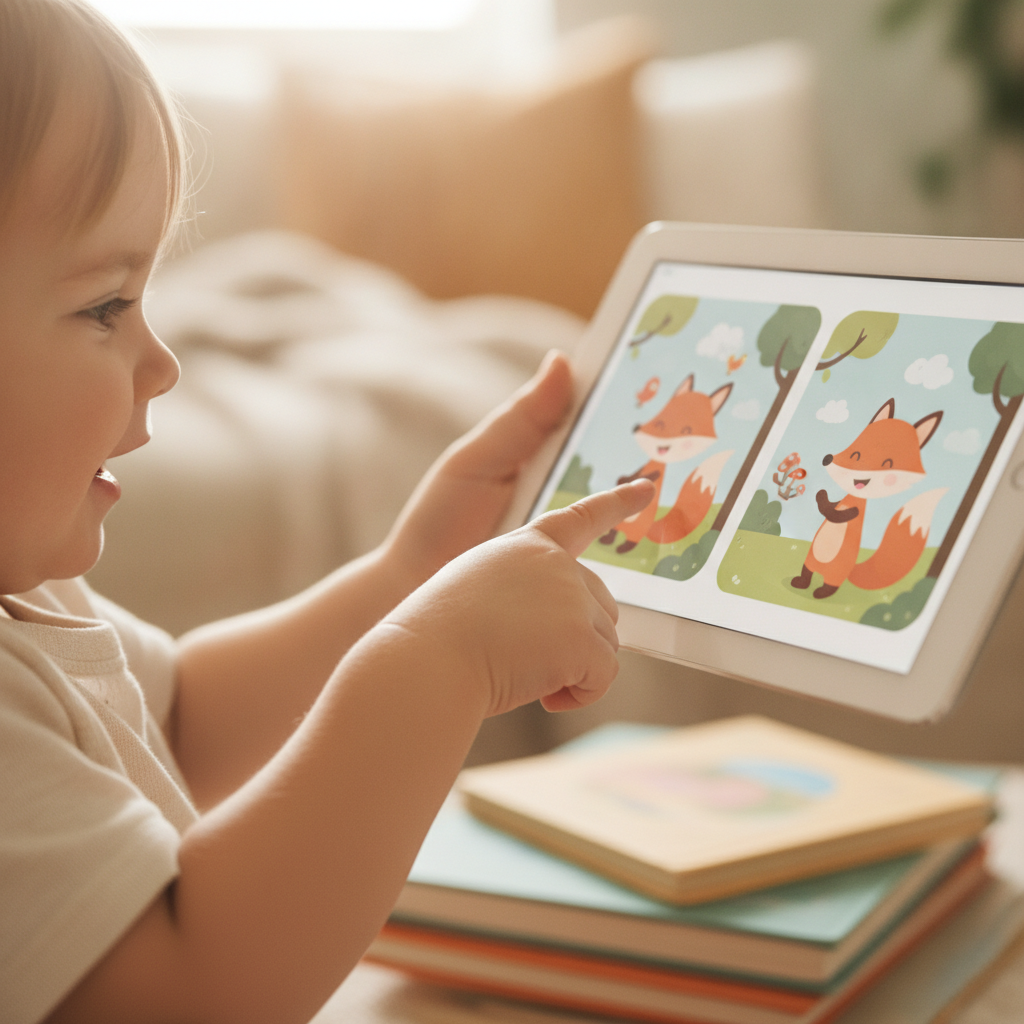
Play together for more meaning
Instead of letting your child scan alone, sit alongside and make it a conversation:
- Ask open prompts: "What if you look closely at the top-left corner?"
- Praise the effort, not the result: "You're being so patient looking!"
- Name details to grow vocabulary: "Oh, the hat changed color!"
You can try Wolfoo Spot the Difference together — free, with familiar characters and difficulty that builds gradually, suitable from about age 4. A few minutes of playing together trains observation and creates a moment of connection.
Keep it balanced and healthy
Spot-the-difference is just one part of your child's day. Mix it with outdoor play, reading, and real-life "differences" ("What's different at the playground today?"). A little intentional screen time, with you alongside, is far more valuable than passive scrolling.
FAQ
What age can play spot-the-difference?
Many children enjoy it from around age 4 with simple pictures and few differences. Choose a level that fits and increase difficulty as they get comfortable.
What if my child gives up quickly?
Pick easier pictures with fewer differences, and play along to cheer them on. Keep each round short and fun.
Does it really help with reading?
It doesn't teach letters, but it builds visual discrimination and focus — foundations that support reading. Treat it as a helpful add-on alongside daily reading.
Next time your child is intently "scanning" two pictures, you'll know they're practicing a valuable skill. Sit down beside them, search together, and laugh together — that's the best part of all.
— The Wolfoo Games Team