

Why Is My Child So Shy Around Other People?
Your child hides behind your leg and won't say hi at parties? That's usually normal temperament, not a problem. Here's how to help, gently.
Short answer: if your child clings to your leg at a birthday party, stays silent through the first weeks of a new class, or takes several minutes to say a single word to someone new — that's almost always a "slow to warm up" temperament, not a sign something is wrong. It's worth a closer look only when that caution starts blocking your child from everyday, age-appropriate activities: school, playdates, group activities.
A familiar scene: a classmate's birthday party. Other kids run straight into the games, but yours plants themselves behind your leg, one fist gripping your jeans, eyes on the floor. You crouch down and say "go play with the other kids," and they shake their head. You're half tender toward your child, half self-conscious about the other parents glancing over.
Why is my child so shy — a personality trait or something to fix?
According to Children's Hospital of Philadelphia (CHOP), it's normal for young children to form strong attachments to their primary caregivers and feel wary of unfamiliar people. Some kids simply need more time to adjust to new people and situations — CHOP calls this a "slow to warm up" temperament, not a flaw.
In other words, your child isn't "broken" for taking 15 minutes to say a word at a party. That's how their nervous system processes something new — and that pace varies from child to child.
What's actually going on in your child's head in that moment?
At preschool age, the strong bond with a primary caregiver can make anyone unfamiliar — even another child the same age — feel like an unknown that takes time to figure out. As kids get a bit older, into early elementary school, the worry can shift shape: fear of saying the wrong thing, fear of being laughed at, fear of being looked at when the whole room turns toward them, per CHOP's observations. A child clinging to your leg at the playground at age 3 and a child too nervous to raise their hand at age 7 may be dealing with two slightly different worries, even though both look the same on the outside: quiet, standing off to the side.
What parents can actually do — without pushing your child out of their comfort zone
CHOP suggests a few concrete ways to support a shy child, without demanding they "just get over it":
- Prepare ahead of time. Tell your child who will be there and what will happen, so nothing catches them off guard. Try: "At Bin's house there'll be two more friends. We'll build with blocks first."
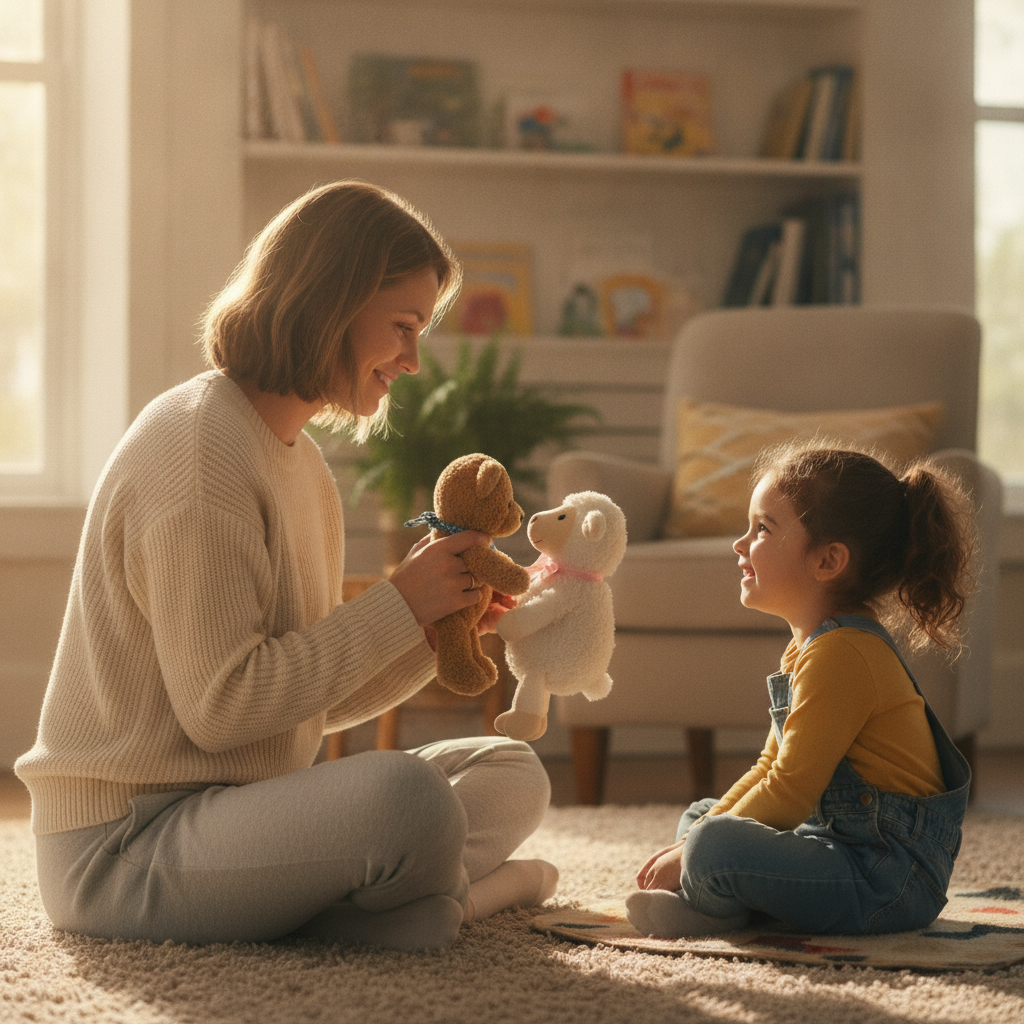
- Practice gently. Role-play the interaction at home first — who says hi to whom, what to say. Help your child find one small shared interest to open with, like "You like superheroes too?"
- Praise the effort, not the outcome. Try: "You said hi to Bin — that took courage!" — even if that's the only sentence they managed.
- Name the feeling before pushing forward. "I noticed you got quieter after the park today. How were you feeling?" — ask, don't demand an answer right away.
You don't need all four at once. Pick one or two that fit your child, and use them consistently rather than trying everything once and dropping it.
Being honest: no game "cures" shyness
No app or game turns a cautious child into an outgoing one after a few rounds of play. Real social confidence gets built through actual conversations, actually standing next to another person in real life — not through a screen.
What a game can offer is a small, low-pressure rehearsal space — a way to get comfortable with the idea of "meeting someone new" or "helping someone out" before doing it for real. Wolfoo Connect Friends has your child link up pairs of friends across five different settings — a playground, a park, a beach, a fair, a party — a gentle way to picture what "meeting a friend somewhere new" looks like before living it. Wolfoo, The Friend's Helper lets your child try on the role of helping kindergarten friends through small missions — a low-stakes way to practice speaking up and offering help, with nobody actually watching in that moment.
Neither game replaces your child actually standing next to another kid and saying "Hi, want to play?" They're just a stepping stone — a place to rehearse that feeling somewhere nobody's judging, before carrying it out to the real playground.
When it's worth asking for real help
Most shy children open up gradually and don't need special intervention. Per CHOP, it's worth talking to a pediatrician when the caution "is impairing their functioning or ability to participate in typical childhood activities — like school, sports or activities." A few specific signs:
- Your child avoids more and more situations over time, instead of gradually growing more comfortable.
- They refuse to join almost any group activity at school, even after weeks of gentle, consistent support.
- A teacher independently notices the same withdrawal compared to classmates — two settings flagging it is worth listening to.
- Your child shows intense distress (crying, trembling, trouble sleeping) before ordinary social situations like school or a birthday party.
Worth saying plainly: the line between ordinary shyness and something that needs more support isn't always crisp, and most research on social anxiety focuses on older children, roughly age 8 and up, not preschoolers. For kids ages 3-7, the more reliable signal is whether the caution is blocking everyday life — not simply whether your child tends to be quiet.
Frequently asked questions
Is shyness a psychological problem?
Usually not. Shyness is a normal temperament trait, not a disorder. It's worth a professional opinion only when it blocks your child from everyday activities.
When does shyness become something to worry about?
When avoidance keeps growing instead of easing over time, or your child shows intense distress in ordinary, age-appropriate social situations.
How can I help my shy child feel more confident meeting new people?
Prepare them for what's coming, practice gently at home, praise effort over outcome, and give them time — don't demand they say hello right away.
Do the games you mentioned cost anything or require an account?
No, Wolfoo's browser games are free to play, no install or account needed, designed with child safety in line with COPPA, with parental controls and age-appropriate, non-personalized ads.
Related reading
Want a gentler way to rehearse social situations at home? See Pretend Play With Your Child. If your child also struggles to wait their turn or keeps interrupting when playing with others, Why Does My Child Keep Interrupting? may help too.
Sources
- Children's Hospital of Philadelphia (CHOP) — "Shyness in Kids," featuring Katie K. Lockwood, MD, MEd.
- Child Mind Institute — "Understanding Social Anxiety in Children."
This article is for general information only and isn't a substitute for professional medical or psychological advice. If you're concerned about your child's social behavior, talk with a teacher, pediatrician, or child psychologist.