What Is My Kid Watching? 6 Ways to Spot AI Slop — and a 10-Minute Daily Play Routine to Replace It (Ages 3–7)
AI slop is flooding kids' channels. Here are six ways to spot it in 30 seconds — and a ten-minute daily rotation to give your child something better instead.
One evening you glance over at the tablet and something is off. The character looks familiar but isn't quite anyone. The narration is flat. A hand has six fingers. The text on the screen is a smear of letter-shapes that spell nothing. Your child is watching, rapt. And you think: where did this come from, and what is my kid learning from it?
If you have had that moment, you are not alone. The content now has a name — AI slop: machine-generated video, produced at industrial scale, labelled "educational for toddlers", uploaded dozens of times a day. A Kapwing analysis in November 2025 estimated that roughly 21% of what surfaces in YouTube's feed is low-quality AI-generated video.
This article has two halves. First: how to spot it in about thirty seconds. Second — and we think this is the more useful half — what to give your child instead, ten minutes at a time.
Why your child is drawn in — and can't tell it's wrong
The first question most parents ask is, "how does she not notice?" The answer is about age, not about your child.
Children aged 3–7 don't yet have the filter adults use without thinking: this is real, this was made up by somebody. In their advisory on AI toys, Fairplay and the Center for Digital Democracy cite a number worth pausing on: 75% of children aged 3–10 believe a household voice assistant always tells the truth. At this age, if it appears on a screen and talks, it is trustworthy by default.
These videos are also built to exactly the formula that catches a young child: saturated colour, fast cuts, looping music, familiar-looking characters. Your child isn't hooked because the content is good. They're hooked because it presses the reflexes of a four-year-old.
So if your child watches without blinking, that is age-typical — not a sign that they're gullible or that you weren't paying attention.
What harm does AI slop actually do to young children?
There are three layers, and child development researchers have named all three.
1. It gets the foundations wrong
Carla Engelbrecht — who built digital experiences for Sesame Street, PBS Kids and Highlights for Children — has documented "teaching" videos that get the most basic things wrong: naming one colour as another, explaining traffic lights incorrectly. Her point isn't that a child picks up one wrong fact. It's that the child has to process contradictory signals, which pushes back every learning milestone that was meant to follow.
2. The brain is being wired, and this wires it wrong
Dr. Dana Suskind, professor of surgery and pediatrics at the University of Chicago, offers a phrase that sticks: with adults we talk about "brainrot", but for young children the accurate word is brain stunt. The reason is concrete. At this age every experience is building "a million new neural connections". Wrong content isn't just wrong information — it contributes to wiring built the wrong way.
3. Unsafe scenes a child may copy
These videos have been found showing children riding in cars without seatbelts, eating whole grapes, and being given foods that are not safe for infants. Children aged 3–7 learn by imitation — which is the whole difference between bad content aimed at adults and bad content that reaches small children.
Professor Kathy Hirsh-Pasek (Temple University and the Brookings Institution), one of the most-cited researchers on play and language development, calls this plainly a "monster problem". Her advice is short: help your child separate the slop from the good stuff.
6 ways to spot an AI video in 30 seconds
You don't need to become an expert. These six catch most cases — and the most important tip is at the end.
- Hands and finger counts. Still the most reliable tell. Six fingers, fingers fused together, hands that deform when a character picks something up.
- Warped, meaningless text. Shop signs, alphabet charts, numbers on a birthday cake — letter-shaped from a distance, unreadable up close.
- Characters that change mid-video. A blue shirt turns red, eye colour shifts, the dog gains a leg. The model doesn't remember its own characters.
- Flat narration with the wrong rhythm. Emphasis in odd places, strange pauses, emotion that doesn't match what's on screen.
- A channel uploading far too fast. Tap the channel name and look at the dates. Dozens of videos a day means nobody made them one at a time.
- Keyword-stuffed titles, bait thumbnails. Endless titles jamming together every character name going, with a crying face or a shocked expression on the thumbnail.
And here's the tip that matters most: don't just watch the first thirty seconds. These videos often open cleanly and fall apart later — the worst errors tend to sit in the middle. Drag the scrubber to the halfway point and watch a minute there.
4 things you can do today
- Turn off autoplay. This is the single biggest change available for one tap. The first video is usually the one you chose; the fifth is the one the algorithm chose.
- Build your own playlist. Ten to fifteen videos you've actually watched, and your child watches inside that list. It costs you one evening and lasts months.
- Sample the middle before allowing a new channel. One minute halfway through tells you more than three minutes at the start.
- Ask one question. Not as a test, but to build the habit of thinking: "In that video, what was real and what did somebody make up?" A four-year-old getting it wrong is fine — what matters is that the question gets asked.
Something to say out loud. Instead of switching it off abruptly: "Let's watch one minute of this together and see if it's any good — then we'll pick something." Bringing your child into the choosing produces far less resistance than having the tablet taken out of their hands.
Swapping the endless scroll for ten minutes that ends
It's worth saying plainly what actually worries us here. It isn't the tablet. It's video that nobody is accountable for and that never reaches an ending.
If that's the problem, the answer isn't cutting screens out. It's swapping in a different kind of screen: something a person made, with levels, with a clear stopping point.
The American Academy of Pediatrics' January 2026 guidance points the same way. It no longer sets a fixed number of hours, and instead asks three questions: what the content is, what it's replacing, and whether anyone is there with the child.
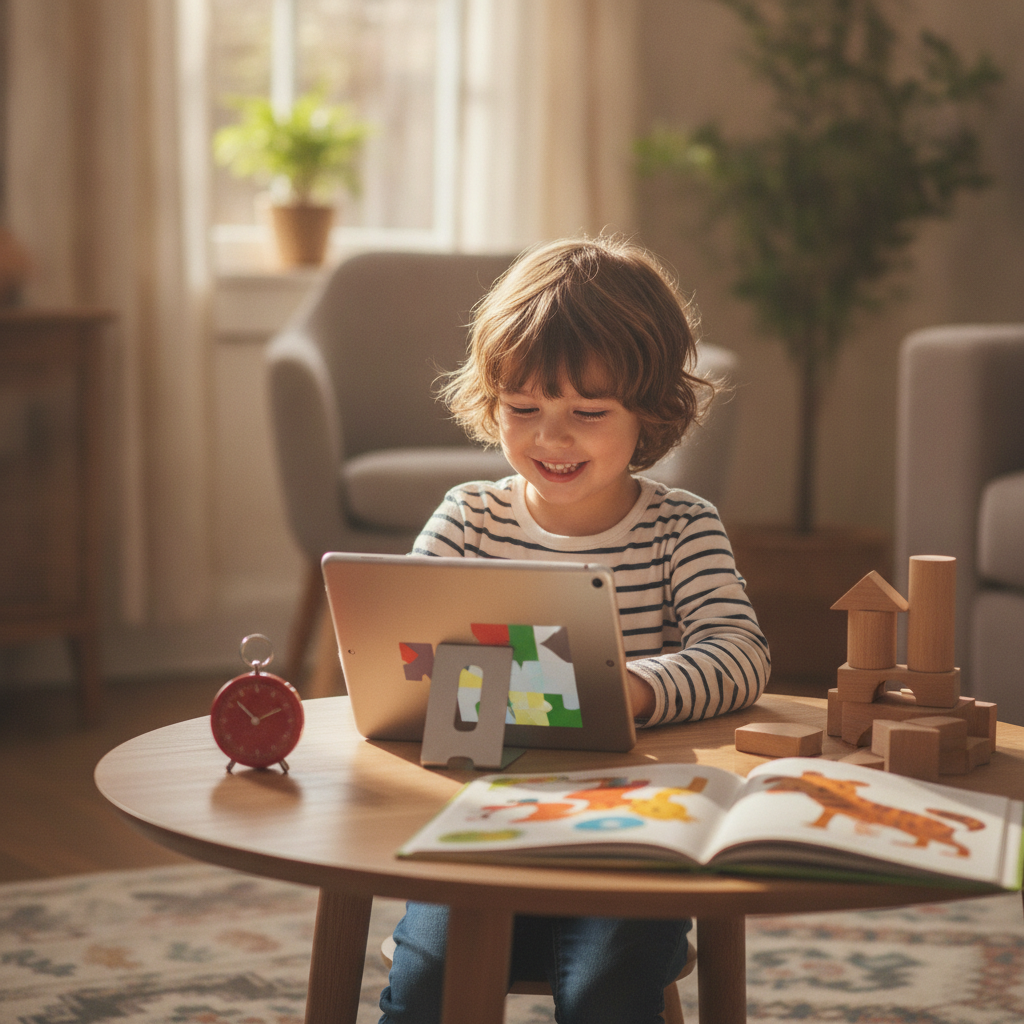
The simple rhythm: ten minutes a day, a different kind of play each day
Children gravitate hard toward one kind of activity. That's normal — repetition is how they build mastery. But a week that runs in one lane is a narrow week. In The Power of Play, the AAP makes the case that it is the variety of play that does the most for a young child.
So the rhythm we'd suggest isn't "play more". It's "rotate":
- Letters and sounds — Wolfoo Spell It, Wolfoo Word Wonders
- Numbers and reasoning — Wolfoo One Line Magic, Wolfoo Drop Merge 2048
- Shape and space — Wolfoo Tangram, Wolfoo Spot the Difference
- Movement and timing — Wolfoo Town Run 3D
- Watching and repeating — Wolfoo Sequence
- Playing with others — Wolfoo Team Up!
- Self-control and memory — Wolfoo Don't Play, Wolfoo Memory Match
- Sorting and noticing — Wolfoo Supermarket Sort, Wolfoo Blossom Garden
If your child is 3–5, pick the simplest ones: Wolfoo Learning Land, Learning Colors with Wolfoo, Wolfoo Tangram. At this age, you sitting alongside matters more than which activity you choose.
One important note. We use the eight groups above to categorise activities, not children. Children aren't "types". Howard Gardner's eight-intelligences framework is a useful way to organise activities, but researchers have not found evidence that these are separate abilities in the brain. What is well supported is far simpler: varied play beats narrow play.
Two things that make this work
Set the timer before you start, and tell them. The hard part has never been starting — it's stopping. A visible countdown turns the ending into "time's up" rather than "mum made me stop", and that is the whole difference.
Don't let the streak become pressure. Missing a day is fine. Five varied days beats seven identical ones.
We've grouped the games into these eight kinds of play on the Play Streak page, so each day you just open it and pick today's kind. If you'd rather follow a day-by-day schedule, there's the 8-day plan; if you want to understand the eight groups more deeply, read our piece on the 8 types of intelligence in children aged 3–6.
Common questions
Is all AI-made kids' content bad?
No. There are careful producers using AI as a tool, with writers, reviewers and someone accountable at the end. The problem is content mass-produced with nobody checking it, published for the single purpose of collecting views. What's worth filtering out is the method, not the technology itself.
Does YouTube Kids block AI slop?
Not fully. YouTube Kids has filters and age tiers, but the volume arriving each day is too large to screen in time — in April 2026 more than 200 organisations signed a joint letter to YouTube and Google about exactly this. Building your own playlist and turning off autoplay still does more than trusting the default settings.
What should a 3-year-old do instead?
For a three-year-old, shorten it to five or seven minutes and choose the simplest options — Learning Land or Learning Colors with Wolfoo. But honestly, at this age the most valuable things are still blocks, picture books and you sitting next to them. A game should be one small layer in the day.
Is ten minutes a day really enough to build my child's intelligence?
We won't promise that, and you should be wary of anyone who does. What ten minutes a day can do is more specific: it keeps your child used to switching tasks, holding attention for a stretch, and following instructions — the things that tend to blunt over a long break or across a run of scrolling afternoons. It complements hands-on play; it doesn't replace it.
Do the games cost anything, or need an account?
No. They run in a browser, free, with no download and no account needed. The site is COPPA-compliant, serves non-personalised advertising in line with the rules for children's services, and has a parental controls page. We don't collect personal information from children. If you'd like the detail, there's a separate piece on how safe Wolfoo Games is.
Where to start
Tonight, do one thing: turn off autoplay on whichever device your child uses. One tap, and it closes off most of the route this content takes in.
Then tomorrow, try the kind of play your child has touched least this week. Set a ten-minute timer. Sit with them for the first few minutes. You can start from the Play Streak page, or browse every game by age. Play free, keep your streak.
References
- Fairplay & Center for Digital Democracy — AI Toys Are NOT Safe for Kids (advisory, November 2025).
- Undark (March 2026) and The 74 — interviews with Prof. Kathy Hirsh-Pasek (Temple University, Brookings Institution), Dr. Dana Suskind (University of Chicago) and Carla Engelbrecht on AI content in children's media.
- Kapwing (November 2025) — estimate of low-quality AI video in YouTube's feed.
- American Academy of Pediatrics — The Power of Play (2018) and digital media guidance for families (January 2026), healthychildren.org.
- Howard Gardner, Frames of Mind (1983); Waterhouse, L. (2023), Why multiple intelligences theory is a neuromyth, Frontiers in Psychology.