

Do Tablet Games Actually Build Fine Motor Skills?
Your child swipes a screen easily but struggles to hold a pencil? What research says about games and fine motor skills — and what screens can't replace.
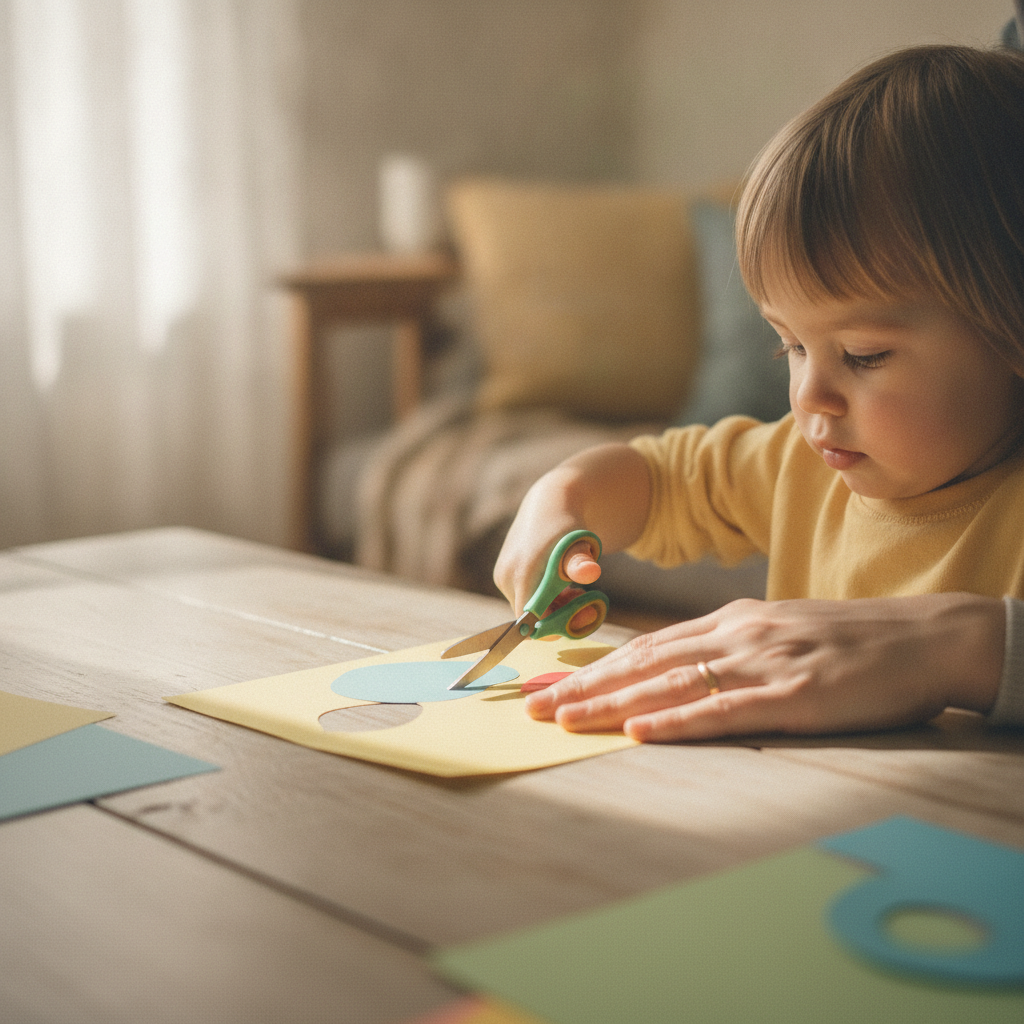
Short answer: a few small studies suggest that apps specifically designed to train hand movement — like stylus-based handwriting apps — can produce a modest improvement in manual dexterity. But that's a finding about purpose-built apps, not ordinary tap-and-swipe games. And whichever app you pick, none of them replace a child actually holding real scissors, squeezing play-dough, or threading beads with their own hands.
Here's a scene a lot of parents recognize: your child swipes through a phone screen in a blink, hitting the exact right spot every time — then hands you a drawing where the crayon lines wobble outside the edges, or cuts along a line on paper and ends up a full inch off. You watch and wonder: why doesn't "good with a screen" turn into "good with a pencil"?
What "fine motor skills" actually means, and why it matters before kindergarten
Fine motor skills are the small-muscle movements of the hand and fingers: holding a pencil correctly, buttoning a shirt, using scissors, threading beads, fitting small pieces together. These are the direct foundation for handwriting later on — without enough fine motor strength, a child's hand tires quickly during writing practice, regardless of how sharp they are otherwise. According to guidance from occupational therapists at The OT Toolbox, this skill develops most actively between ages 3 and 6, through activities that use finger strength and two-hand coordination.
Do screen games actually build fine motor skills?
This is the interesting part: yes, but only for one specific category of app — not every tap-and-swipe game out there. A study published in Research in Learning Technology followed 125 kindergarten children (67 in a control group, 58 using an additional app), and found that the group practicing with a stylus-based handwriting app — not finger-tap input — showed a significant improvement in manual dexterity (p < 0.03) compared to paper practice alone. Worth noting: handwriting legibility improved about equally in both groups — the app added a dexterity benefit, it didn't make handwriting itself better than paper practice did.
A separate study by researchers in Australia followed 53 children aged 5–6 across two pre-primary classrooms, having them use apps specifically designed to target motor skills for 30 minutes a day over 9 weeks. Measured with the Beery visual-motor test, the intervention group showed a moderate improvement, and the authors described it as "preliminary evidence" — not a settled conclusion, and not a claim that applies to games in general.
The common thread in both studies: the app has to be purpose-built for motor practice — stylus input, high precision requirements, repeated targeted movements. An ordinary finger-painting or screen-swipe game isn't the kind of app either study tested.
So what do "ordinary" games like tangrams or pixel art actually do?
They don't directly train hand muscles the way holding a real pencil does, but they're not pointless either. Games that ask a child to drag, rotate, and place small pieces exactly where they belong build hand-eye coordination and the patience to try again until it fits. That's a useful stepping stone — getting comfortable with "that wasn't quite right, try again" before moving to something that demands more precision, like handwriting.
What a screen still can't do
Being honest here: no app, however well designed, replaces the feel of real scissors in your child's hand, the resistance their thumb and fingers push against when squeezing play-dough, or the texture of a bead sliding onto a string. A flat screen has no resistance, no weight, no real tactile feedback — and those are exactly the things that build hand strength. The OT Toolbox emphasizes simple at-home activities instead: threading beads, play-dough, using tweezers to pick up small objects, practicing buttons, and cutting along a line on paper — none of these have a true screen equivalent.
A reasonable way to combine both
This isn't an either-or choice. A few minutes of hand-eye coordination games a day, plus 10–15 minutes of real hands-on activity — coloring with crayons, threading beads, cutting simple shapes — covers most children ages 3 to 7 well.
Try saying: "Let's finish this level, then go cut some shapes for our card?" — turning the transition into something to look forward to, not a command.
A concrete tip: keep crayons, child-safe scissors, and paper somewhere your child can reach on their own. Fine motor skills build best when a child chooses the activity themselves, not when it's framed as mandatory "craft time."
A few games for hand-eye coordination before moving to paper and pencil
Wolfoo Color Learning (ages 3–7) has your child tap precise spots again and again — a gentle warm-up for targeting accuracy before holding a real pencil. Wolfoo Tangram (ages 3–8) asks your child to drag and rotate each shape piece into its exact spot, close to how kids fit wooden blocks together in real life — good practice for trying again without frustration. Wolfoo Birthday Pixel Art (ages 4–12) has your child fill in small numbered cells one at a time, practicing focus and precision within a tight space — not unlike coloring inside the lines with a real crayon.
When it's worth asking a professional
Kids vary a lot in how fast their hand skills develop, and that's normal. A few signs are worth raising with a teacher or an occupational therapist rather than waiting it out:
- Your child still grips a pencil with a whole-fist grasp (like holding a stick) at ages 5–6, rather than a three-finger grip.
- Your child avoids hands-on activities like coloring, building, or cutting altogether — not just disinterest, but apparent avoidance because it's hard.
- Your child struggles noticeably more than same-age peers with buttons, zippers, or shoelaces, over several weeks rather than one off day.
- A teacher at school independently notices the same pattern.
Frequently asked questions
At what age should a child hold a pencil correctly?
Most children settle into a stable tripod grip somewhere between ages 4 and 5, though a gap of a few months to over a year between kids is normal and not an immediate red flag.
Do coloring apps on a phone help with pencil grip?
Not directly. The dexterity benefit shown in research applies to stylus-based apps purpose-built for that goal — not every finger-tap coloring game.
Is it a problem if my 5-year-old still struggles with scissors?
Not necessarily. Many children need a few more months of practice. It's worth a professional opinion only if they avoid it entirely or lag noticeably behind peers for an extended period.
Do we need to buy a specialized handwriting app?
Not necessarily. Real hands-on activities — play-dough, threading beads, cutting paper — remain the most effective and free way to build fine motor skills at this age.
If you're wondering what other skills matter before kindergarten, our 5-skill readiness checklist through play touches briefly on pencil grip and goes deeper into the rest. And if your child is currently obsessed with one single game, 8 skills kids learn through play also mentions the hand-eye coordination group this topic builds on.
Sources
- Study published in Research in Learning Technology (2019) — on manual dexterity improvement in kindergarten children using a stylus-based handwriting app alongside traditional paper practice.
- Study by researchers at Australian Catholic University — on a 9-week, 30-minutes-a-day iPad motor-skill app intervention improving hand-eye coordination in children aged 5–6 (measured with the Beery test), described by the authors as "preliminary evidence."
- The OT Toolbox — occupational therapist guidance on fine motor development milestones and activities for preschool-age children.
This article is general guidance for parents and isn't a substitute for a professional evaluation from an occupational therapist or pediatrician.