

Why Does My Child Get So Restless Stuck Indoors All Afternoon?
Your child bouncing off the walls indoors isn't bad behavior — it's often just missed movement. Here's what actually helps.
Short answer: if your child is bouncing off the furniture, squabbling with a sibling over nothing, or turning the living room into an obstacle course the moment you're stuck indoors for an afternoon, that's usually not defiance or a discipline problem. Kids ages 3 to 7 need more daily movement than most adults realize, and when that movement gets cut short because going outside isn't an option, the extra energy has to go somewhere — often showing up as restlessness, squabbling, or a meltdown over something tiny.
It was barely 4pm on a rainy Saturday, and my two kids (ages 4 and 6) had turned the living room into a racetrack after just two hours indoors — jumping between couch cushions, fighting over the remote, then a full meltdown over who got to hold it first. I was on the floor gathering pillows, wondering how they'd gone from calm at breakfast to this. It turned out the answer was simpler than I expected: they weren't being difficult, they just had nowhere to put all that leftover energy.
Why does my child get so restless when we're stuck indoors?
According to the Canadian Paediatric Society, via its Caring for Kids resource, preschool-age children need at least 3 hours of physical activity a day, spread throughout the day, including both planned activities and free play — and by age 5, that should include at least 60 minutes of energetic play daily. That's not an ambitious ideal; it's considered a normal baseline for healthy development at this age.
When rain, cold, or an early sunset keeps a family indoors more than usual, that movement quota quietly goes unmet — until it resurfaces as jumping on the bed, running laps around the house, or snapping over something small. This is the body looking for balance, not your child deliberately pushing back on you.
Does movement only "count" if it happens outside?
Not really. According to exercise physiologist Rachel DeHaven (Children's Hospital of Philadelphia), the American Heart Association's recommended 60 minutes of daily exercise doesn't have to happen in one block — a few 10-to-15-minute stretches spread through the day work just as well. Indoor movement counts too, as long as it's actually active: jumping, running in place, or safely climbing over cushions.
A few low-prep indoor ideas you can try right now:
- A 10-minute dance break. Put on an upbeat song and move together, no choreography required — the point is just continuous movement.
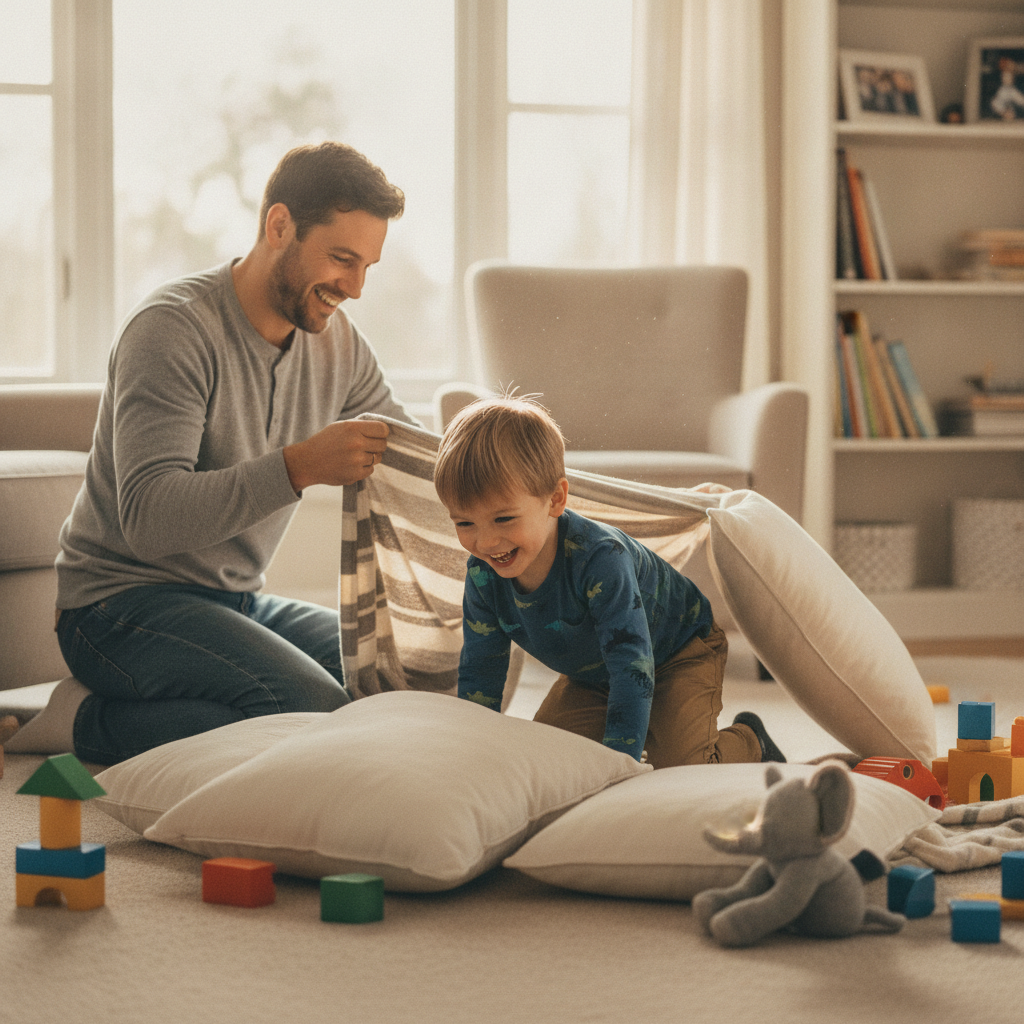
- A pillow-and-cushion obstacle course. Stack pillows, blankets, and chairs into a short course to crawl under, jump over, and weave through.
- A "move jar." Write a few simple actions (10 jumping jacks, run in place, reach up and touch the ceiling) on slips of paper for your child to draw and perform.
- An indoor scavenger hunt. Hide a handful of familiar objects around the living room so your child moves around while searching — lower-key than running laps, but still purposeful movement.
A script that helps when things start escalating: "I can see your legs want to run right now. Let's do 10 jumps and a lap around the living room first, then we'll come back to this." — framing movement as a short transition, not a lecture about sitting still.
What this doesn't fix
Being honest here: none of the activities above drain your child's energy completely in one go, and no screen-based game, however calm, replaces actual movement. On a day when the rain doesn't let up, your child may still have rough moments even when you've done everything right — the realistic goal is fewer and shorter meltdowns, not a child who sits perfectly still all afternoon.
A few calm games for the moments between bursts of movement
After a dance break or a run through the obstacle course, kids usually need a short breather before they're ready to go again. That's where a brief screen-based game can have a reasonable place — not as a replacement for movement, but as a clearly bounded pause between active stretches.
Wolfoo Balloon Up (ages 4-10) mirrors the familiar real-life game of keeping a balloon off the floor — a quick few minutes that's easy to stop, and an easy segue back into batting a real balloon around afterward.
Wolfoo Hidden Hunt (ages 4-10) builds observation and patience, basically a seated version of the indoor scavenger hunt above. Wolfoo Book Sort (ages 4-10) turns tidying into a short, slow-paced "mission" — good for a few settled minutes that still feel like accomplishing something.
When it's worth asking for real help
- Restlessness or meltdowns continue for several weeks with no improvement, even after adding more indoor movement.
- Your child shows clear aggression — hitting, biting, throwing things — beyond ordinary restlessness.
- A teacher also reports trouble sitting still or focusing at school, not just at home.
- Your child seems tired and irritable all day, not just during stretches indoors.
If you're seeing these signs, talking with a teacher or a pediatrician will help more than adjusting things on your own at home.
FAQ
How much indoor movement does my child actually need each day?
Per Caring for Kids (Canadian Paediatric Society), preschoolers need roughly 3 hours of physical activity a day, spread out — it doesn't need to happen all at once or outdoors.
Does 10 minutes of indoor movement actually make a difference?
Yes. The American Heart Association notes that short bursts of activity (10-20 minutes) across the day add up to the same benefit as one longer continuous session.
My child only gets wild on rainy days — is that something to worry about?
Mostly no. It's usually just a response to getting less movement than usual, and it tends to ease once your child gets enough activity that same day.
Would more screen time on a rainy day actually calm things down?
Usually not for long, since the root issue is missed movement, not a lack of entertainment. A short burst of activity first tends to work better than extending screen time.
Do the games mentioned cost anything or need an account?
No, Wolfoo's browser games are free to play, with no install or account needed, designed with child safety in line with COPPA, and showing age-appropriate, non-personalized ads.
If evenings are also thrown off by the clocks changing, Clocks Fall Back Soon: How to Help Your Child's Sleep Adjust has more on resetting that schedule. And for more screen time alternatives in general, Screen Time Alternatives for Kids has further ideas.
Sources
- Canadian Paediatric Society — Caring for Kids, Physical activity for your preschooler, on recommended daily activity levels for preschool-age children.
- Rachel DeHaven, MPH (Children's Hospital of Philadelphia), citing American Heart Association guidance on 60 minutes of daily exercise, which can be split across the day.
This article is for general information only and isn't a substitute for professional medical or psychological advice.