

Screen Time Guilt: What the Research Actually Says
Short answer: your guilt doesn't track with actual harm. Here's what research says really matters, and how to make screen time feel intentional.
Short answer: the guilt you're feeling right now doesn't track with how much your child is actually affected. One study following hundreds of parents found guilt was barely related to actual screen time hours — but closely tied to the parent's own stress level.
It's 9pm, your child is asleep, and you're scrolling your phone replaying this afternoon: a meltdown in the checkout line, a tablet handed over just to get through it. This morning at the park, another parent mentioned their kid "barely touches a screen," while yours had just watched two episodes back to back so you could get dinner started. If you're replaying that same tape tonight, you're not alone — and the research below might help you breathe a little easier.
Why parents feel guiltier than the actual impact on their child
Researcher Robin Nabi, PhD (University of California, Santa Barbara) surveyed parents during the 2020 pandemic lockdowns and found 73% reported some guilt about their child's screen use, with nearly half (48%) at a moderate-to-intense level. The surprising part: guilt showed little to no relationship with actual screen time duration — but it was closely tied to parental stress, and that stress in turn was linked to lower satisfaction in the parent-child relationship. In other words, the guilt itself, not the tablet, may be what's actually straining the room.
Comparing yourself to another parent — "their kid barely touches a screen and still turns out fine" — usually just makes this heavier, because you can't see what that family's day actually looks like behind closed doors. Every household runs on a different rhythm.
The hour count isn't the whole story
Recent pediatric guidance has shifted toward quality over a raw hour count. Co-viewing — watching or playing alongside your child and actively engaging, not just being in the room — is associated with positive effects on executive function and language development. On the other hand, it's parents using their own phones during time meant for interacting with their child (meals, playtime) that's been linked to poorer cognitive and psychosocial outcomes.
So when is screen time actually worth worrying about — versus just guilt?
A 2024 study published in JAMA Network Open found preschoolers with 2 or more hours of daily screen time showed lower psychological well-being compared to those under 1 hour. That's an association found within the group studied, not a hard cutoff that applies identically to every child — but it's a useful real signal: if screens are filling most of your child's day with no one engaging alongside them, that's worth adjusting. That's a very different situation from feeling bad about 20 minutes of cartoons so you could cook dinner.
Being honest here: no game erases guilt, and no game turns two hours of solo screen time into something good for your child. What actually makes the difference isn't which game — it's whether you're sitting with your child, and what they're doing during that time.
Making screen time feel intentional, not something to hide
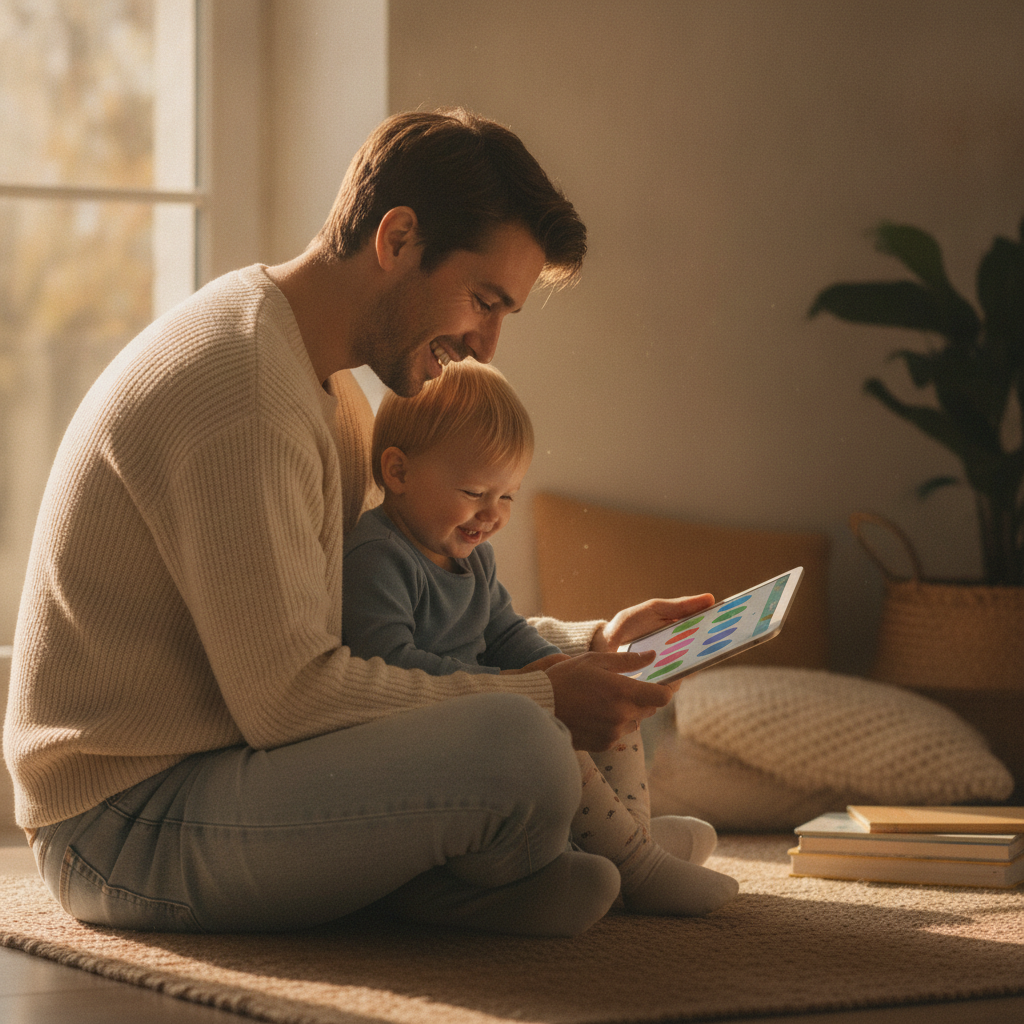
According to Zero to Three and researchers at the Georgetown Early Learning Project, two things decide the outcome: content and context — what your child is watching or playing, and whether someone connects it back to real life. A few things worth trying today:
- Pick games with a natural stopping point. Learn Colors with Wolfoo builds color recognition for ages 3–7, with rounds that run just a few minutes each — easy to end on a good note instead of a fight.
- Sit through at least the first round. Wolfoo Memory Match has no winner or loser — you're both just focused on finding matching pairs, which builds short-term memory and gives you a reason to sit close.
- Choose patience over reflexes. Wolfoo Tangram builds spatial reasoning and patience through slow, deliberate puzzle-solving — no endless scroll, no reflex pressure.
A script that helps before you start: "Let's play two rounds together, then we'll put it away — you pick the first one." And when it's hard to stop: "I get that it's hard to stop when it's fun. It'll still be here tomorrow."
When it's worth asking for real help
Ordinary guilt isn't a medical sign. But if your child's sleep has clearly worsened, they seem unusually irritable, they've lost interest in every other activity, or you notice a real, lasting shift in behavior, talk with your pediatrician for a proper evaluation — rather than trying to self-diagnose from an article online.
Related reading
Want the actual hour-by-age breakdown? See How Much Screen Time Is Right for My Child? Ever panicked about whether your child's game itself was safe? Read The Night I Panicked About My Son's Screen. Looking for a calmer way to end a session? See How to End Screen Time Without a Meltdown.
FAQ
Is it normal to feel guilty about my child's screen time?
Very normal — research finds most parents feel this way. What matters is not letting the feeling make decisions for you.
Does feeling guilty actually help my child?
Not on its own — guilt mainly raises parental stress. It's more useful as a signal to check: are you sitting with your child, and what are they engaging with?
How much screen time should I actually worry about?
Look past the raw number to whether someone is engaging with your child and what the content is. Some research found preschoolers with 2+ hours a day of largely solo screen time trending toward lower psychological well-being.
Should I just cut screens out entirely to stop feeling guilty?
Not necessary for most families. Zero to Three and the Georgetown Early Learning Project both note screens can support learning when the content is age-appropriate and paired with real engagement.
Sources
- Robin Nabi, PhD (University of California, Santa Barbara) — 2020 pandemic-era research on parental screen time guilt, published via the Greater Good Science Center, UC Berkeley.
- American Academy of Family Physicians (AAFP) — "Screen Time in Children: Quality over Quantity."
- JAMA Network Open (2024) — study on screen time and psychological well-being in preschool-age children.
- Zero to Three (Claire Lerner) and the Georgetown Early Learning Project (Rachel Barr) — via PBS NewsHour.
This article is for general information only and isn't a substitute for professional medical or psychological advice. If you're concerned about your child's behavior or sleep, talk with your pediatrician.