
My Kid Only Says Thank You Because I Remind Them — Here's What I Got Wrong
My son says thank you the second I prompt him, then turns right back to his toy — a parent's honest take on real gratitude at this age, and what changed.
Short answer: if your child only says "thank you" the second you prompt them, then turns right back to whatever they were doing — that's not a sign of an ungrateful kid or a parenting mistake. At this age, the words usually come first, memorized as a social script, while the actual feeling of gratitude tends to show up much later.
On my daughter's 4th birthday, her grandmother gave her a big box of markers. I nudged her: "What do you say?" — "Thank you!" — flat, fast, almost automatic, and she spun right back around to open the box without another glance at Grandma. Grandma laughed it off: "kids." But that night I kept turning it over: did she actually understand what Grandma had just done for her, or was she just repeating the line I always cue?
Is it a problem that my kid's "thank you" sounds automatic?
No. Harvard Graduate School of Education's Making Caring Common project frames gratitude as more than the phrase itself — it involves noticing who did something for you and thinking about why it mattered, and both of those need regular practice; they don't just appear on their own.
- Kids ages 3-7 can absolutely learn and correctly say "thank you" in familiar situations.
- But actually realizing "Grandma spent time and money picking this out for me" requires taking someone else's perspective — a skill that's still developing at this age.
- The gap between saying the right words and genuinely feeling the thing is normal. It isn't a failure on the child's part or the parent's.
What separates real gratitude from a polite "thank you"?
Making Caring Common's framework points to a "thank you" with actual content — naming what someone did and how it made you feel — as different from a reflexive phrase said just to move on. A survey by Talker Research for Kiddie Academy (October 2025, 2,000 parents of children ages 0-6) found that 95% of parents say it's important for their child to be thankful, yet only 34% say they started teaching gratitude before their child's first birthday — even though most parents expect kids to grasp the meaning of "thank you" by around age 2. In other words, a lot of households (mine included) start later than the timeline we'd set for ourselves.
What I actually changed
I didn't drop the "what do you say?" prompt — that's still a fine first step toward basic manners. But I added a few small things, based on Making Caring Common's suggestions:
- Asking "who helped you today?" at dinner. Everyone names one small thing someone did for them — a teacher who tied a shoelace, a friend who shared a toy. Over time, my daughter started noticing things on her own, without a prompt.
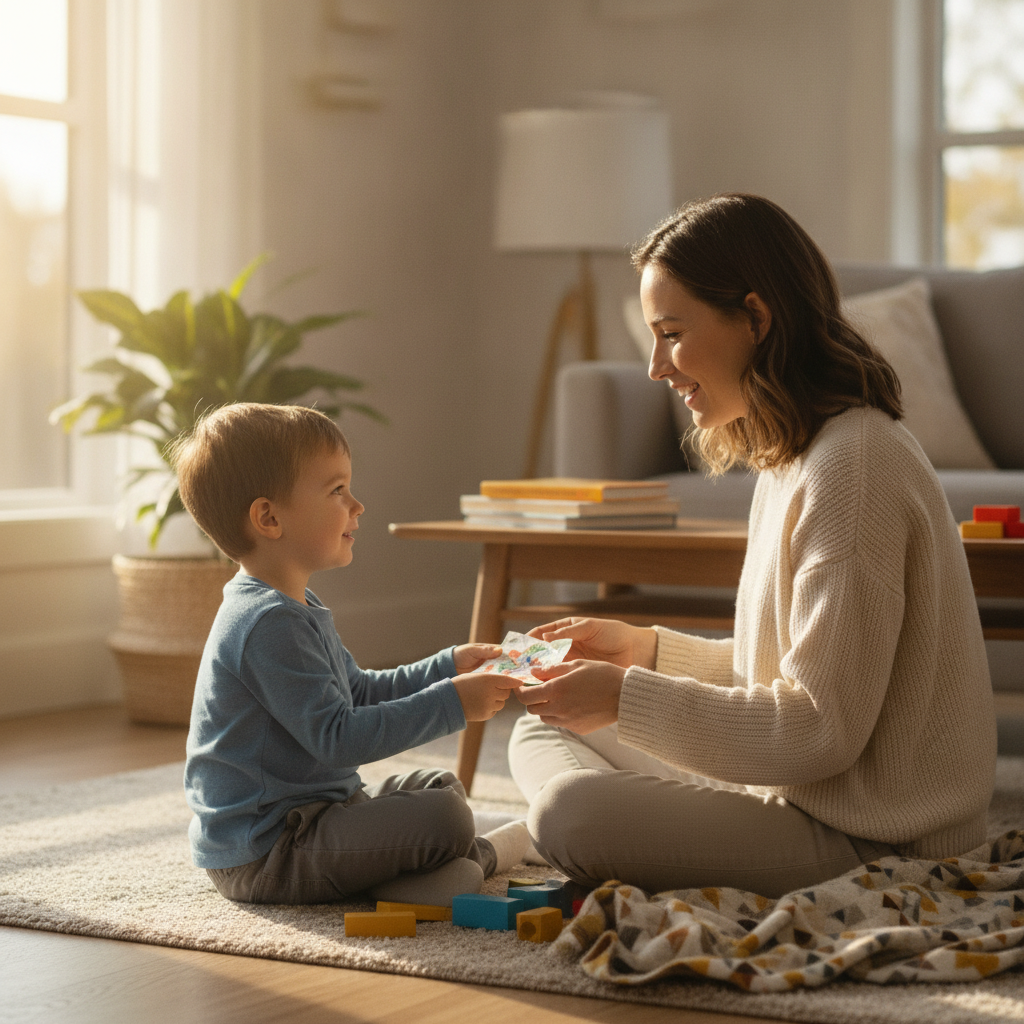
- Letting her draw a card instead of just saying it out loud. I ask what she wants to draw for Grandma and why — even a clumsy answer ("because she gave me pretty markers") is a step further than a bare "thanks."
- Modeling a "thank you" with content, out loud, in front of her. Instead of just "thanks," I say something like, "Thanks for waiting for me — I really appreciated how patient you were." She hears that phrasing enough times, and starts copying it herself.
- Not turning it into a long lecture. Keep it light — a couple of quick questions, no punishment for forgetting to say thanks. Pressure tends to make kids avoid the whole topic later on.
A few games that build the habit of noticing what others do
To be upfront: no game installs a feeling of gratitude, and I don't use these in place of actually talking with her. They're just a gentle way to get her used to noticing other people and helpful actions, playing together before steering the conversation toward the real thing.
Wolfoo's Friend Helper (ages 5-10) has kids role-play helping friends in the game — a concrete way to picture what "helping someone" actually looks like, before talking about how someone else helped them.
Wolfoo's Blossom Garden (ages 3-8) has kids tend a small garden every day and watch it bloom gradually — a gentle metaphor for talking about how someone (a parent, a grandparent) patiently takes care of them the same way, day after day.
What this doesn't do
Being honest: no tip or game suddenly gives a 4 or 5-year-old a deep understanding of what a gift cost someone, in time or effort. The ability to take another person's perspective is still forming at this age, so most of the time, your child's "thank you" will still lean more toward politeness than deeply felt emotion — and that doesn't mean you're doing anything wrong. Plenty of times I do every step right and she still mumbles thanks and runs off to play, and I've learned not to treat that as a failure.
When it's worth a real conversation
- Your child is noticeably older (7-8) and still doesn't notice when someone has helped them, even when asked directly.
- Your child has clear, ongoing difficulty recognizing other people's feelings in general, not just around gratitude.
- Teachers also mention, over several months, that your child shows little interest in peers around them.
If you're seeing these signs, talking with a teacher or a child development professional will tell you more than guessing at home.
FAQ
Does prompting my child to say "thank you" right away backfire?
A gentle reminder is fine — that's how kids learn basic manners. Just avoid scolding or demanding a long apology when they forget, since pressure tends to make kids avoid the topic.
At what age do kids actually understand what "thank you" means?
There's no fixed age for every child. Per the survey above, many parents expect around age 2, but perspective-taking — the real foundation of gratitude — keeps developing well through the preschool and early elementary years.
Should my child write a thank-you note even if they can't write yet?
No writing required. A drawing, a recorded message, or simply picking out a small thing to give back all count as age-appropriate ways to show gratitude.
If you're also building small daily habits with your child, Reward Charts for Kids: Building a Habit, Not a Bargain has more on keeping routines gentle and pressure-free. And if gratitude at your house also comes bundled with toy-sharing struggles, Why Won't My Child Share Toys? has a few related ideas.
Sources
- Making Caring Common (Harvard Graduate School of Education) — Gratitude Is More Than Just Saying Thank You, on gratitude as "noticing" and "thinking," not just a phrase.
- Making Caring Common — Help Kids Show Gratitude, on guiding kids toward concrete ways to show gratitude (cards, drawings, specific words).
- Survey by Talker Research for Kiddie Academy (October 2025, 2,000 parents of children ages 0-6), on parents' views on teaching gratitude.
This article shares a personal parenting experience alongside general guidance for parents, and is not a substitute for advice from a qualified child development professional.