

Why Won't My Child Share Toys? The Real Reason (and What Actually Helps)
Short answer: sharing isn't instinctive at ages 2-4. Here's why, and how to help your child learn to share without forcing it.
Short answer: at ages 2 to 4, sharing isn't instinctive yet — it's a skill your child is still building, not a manner they should already know. Forcing an immediate hand-over usually stops the meltdown in front of you, but it doesn't teach real sharing.
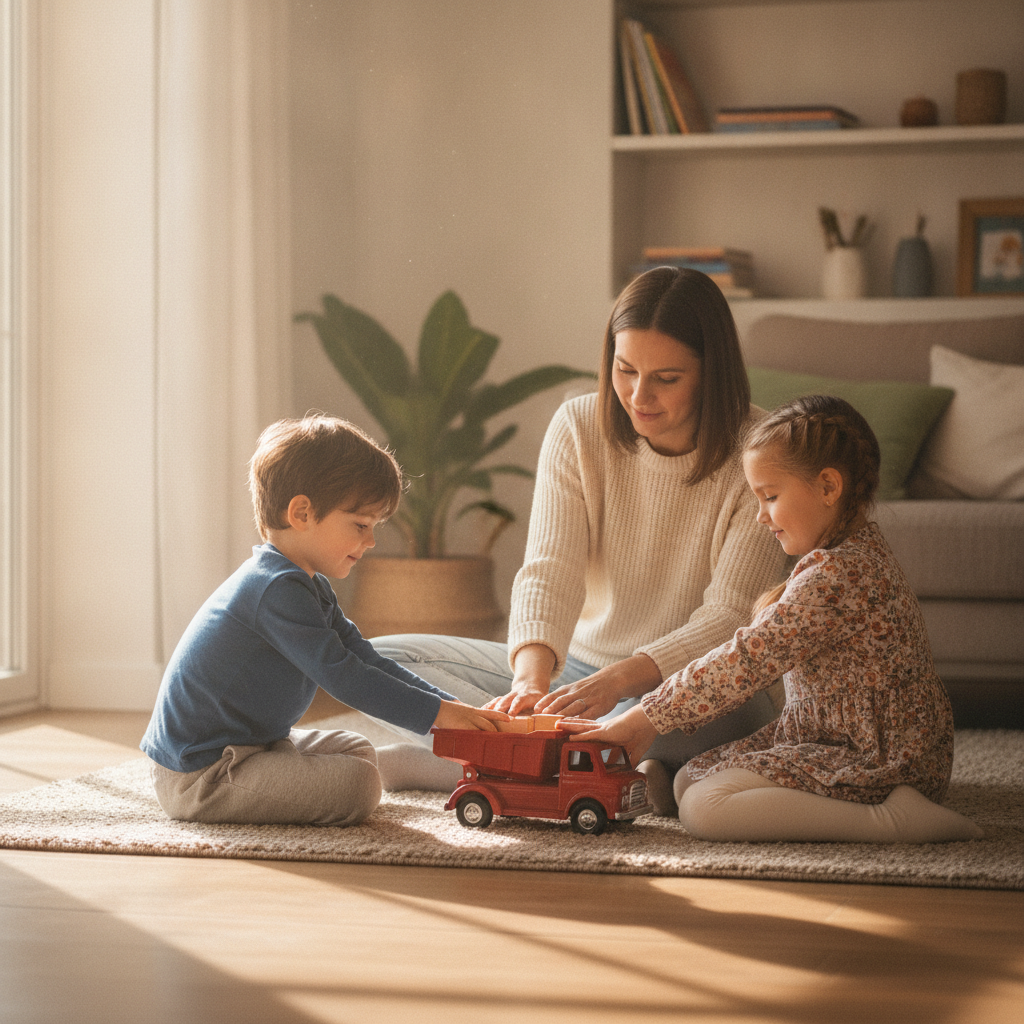
You've probably lived this scene: two kids playing peacefully, then a toy truck sets off a full meltdown — both insisting "mine!", tugging it back and forth, tears following fast. You step in, say "you're the big one, let your sister have a turn," the older one lets go but still looks furious. Ten minutes later, the same scene replays with a different toy.
Why doesn't my child "get" sharing yet at this age?
According to Zero to Three, the sense of ownership — "mine" — shows up very early, well before a child can fully grasp how it feels for someone else to have something taken from them. At 2 to 3, a toy in hand can feel like an extension of the child; letting go isn't simply "being nice," it can feel like losing something certain. It's usually closer to age 4 and up, as perspective-taking (what psychologists call "theory of mind") matures, that a child genuinely understands why a playmate wants a turn too.
In other words, your child isn't being selfish — they're right where their development is at. Knowing this isn't a reason to give up on teaching sharing; it's a reason to worry less when your 3-year-old clutches one toy at a crowded playdate.
Does forcing an immediate hand-over actually teach anything?
Here's the honest part: when a parent says "give it to your sister" and physically takes the toy to hand it over, it usually stops the crying fastest — but that isn't your child learning to share. Some developmental psychology research, including work out of Cornell University, has found children tend to be more willing to share again later when a previous instance of sharing was their own choice, compared to when an adult forced the handoff. Forcing it teaches a different lesson — "if I cry loud enough, the toy gets taken away" — not a lesson about generosity.
That doesn't mean you let two kids fight it out. It means how you step in matters more than whether you step in.
So what actually helps, instead of "let your sister have a turn"?
- Set a clear turn with a timer instead of an immediate handover: "Two more minutes, then it's her turn — I'll set a timer so we both know." Your child keeps a sense of control instead of having the toy suddenly taken.
- Name both feelings out loud: "You're really into this one, and she wants a turn too. Both of those make sense." This helps a child slowly build perspective-taking, rather than just following an instruction.
- Praise the specific action, not the child's character. Instead of "you're such a generous kid," try "You just handed the car to your brother — that was kind." Zero to Three notes that praising the action helps a child repeat it, while labeling character can create pressure to always live up to it.
- Set expectations before a playdate starts. Let your child pick one or two toys that stay "just theirs" for the day — everything else defaults to shared. This alone cuts down a lot of surprise standoffs.
A script for when they're not ready to share yet: "I get that you're not ready to share this one. Let's figure out together when you will be." And when they do share, even briefly: "Your brother is really happy you let him play too. Did you notice that?"
Playing together: a gentle way to practice taking turns
One easy way for kids to practice turn-taking without it feeling like your rule is through games that already build "your turn, my turn" into how they're played. Wolfoo Memory Match is the easiest place to start: siblings take turns flipping cards to find matching pairs, with no early runaway winner, so the urge to grab and rush drops a lot — good from about age 4.
For slightly older kids (ages 5 to 7), Wolfoo Team Up puts two players on the same mission — grabbing keys and dodging obstacles together to reach the exit — so "sharing a turn" flips into "we only win together." Wolfoo, The Friend's Helper walks kids through small scenarios where they help kindergarten friends solve everyday problems — a gentle way to practice noticing what someone else needs, the exact skill sharing depends on.
Being fair about it: no game teaches generosity in a few rounds. This is a small, low-pressure rehearsal space — what actually shifts things is how you respond, day after day, at home. These games are free to play right in the browser, no download required, with a parental controls area, COPPA compliance, and only age-appropriate, non-personalized ads.
When it's worth asking for real help
Struggling to share at ages 2 to 5 is very normal and eases with time. But if a 6-7 year old almost never manages to share even briefly, responds with frequent hitting or biting, or has lasting trouble making friends at school, it's worth talking with a teacher or pediatrician rather than guessing from general milestones alone.
FAQ
At what age do kids share without being reminded?
There's no single age that fits every child, but most start sharing more voluntarily around age 4 to 5, as their ability to understand others' feelings develops further.
Should I make my child apologize right after grabbing a toy?
A forced apology is usually just words. It helps more to calm everyone down first, then talk through what happened together once things are calm.
Is it a problem if my child always gives in and lets others take their toys?
Not necessarily — some kids are naturally easygoing. Pay attention to whether it's a genuine choice or fear of conflict; if it's fear, help them practice safely saying "I want to play with this one too."
Related reading
If siblings in your house fight over toys constantly, see Siblings Always Fighting Over Play? How to Help Them Cooperate and Bond. For more on cooperative play in general, read Playing on the Same Team: Why Cooperative Games Bond You With Your Child. And if your child struggles to wait their turn to talk, Why Does My Child Keep Interrupting? may help too.
Sources
- Zero to Three — "Helping Young Children With Sharing" and "Tuning In: Supporting Sharing": how ownership and sharing develop in young children.
- Developmental psychology research from Cornell University (via news.cornell.edu): children tend to be more willing to share again after a previous sharing instance was a genuine choice, compared to being forced.
- Greater Good Science Center (UC Berkeley): on the development of theory of mind and sharing in preschool-age children.
This article is for general information only and isn't a substitute for guidance from a teacher or a child psychology/pediatric professional. If you're concerned about your child's social behavior, please talk with a qualified professional.