My Kid Asked If a Video Was Real — I Almost Blamed the Wrong Thing
My child asked me a simple question after a strange video, and my first instinct — blaming "AI" for all of it — turned out to be the wrong answer. Here's what I learned, and what I actually watch for now.
Tuesday evening, my son was watching a video on the iPad while I was busy with dinner, when he ran into the kitchen and asked: "Mom, is that rabbit real?" I picked up the tablet to look — a character that looked slightly off, a hand with what looked like one finger too many, narration flat in a way that didn't sound like anyone in particular. My first instinct: this has to be an "AI video", and I almost set myself a hard rule right there — ban anything with AI's fingerprints on it, period. Luckily I paused long enough to think it through a bit more.
My first instinct: blame "AI" for all of it
The problem is that rule doesn't hold up for long. AI is just a tool — like a camera or editing software — and a lot of genuinely good content, including some of the cartoons my son already loves, now uses AI somewhere in how it's made. If I treated "uses AI" as the red flag itself, I'd end up banning things I've let him watch safely for years — which makes no sense. I needed a different question, not "was AI used to make this."
The better question I landed on: who's actually behind this video?
I went back and reread our own piece on 6 ways to spot AI slop in kids' videos, and the line that stuck with me wasn't the list of technical tells — it was one short sentence: what's worth filtering out is the method, not the technology itself. In other words, the problem isn't whether a machine was involved somewhere. It's whether someone is actually accountable for what got published — someone who checked it before it went up, someone who'd fix it if it's wrong, someone who genuinely cares what my child will take away from it.
So I changed the question I ask. Instead of "was this made with AI", I now ask "is there actually somebody standing behind this." A few things I've started noticing:
- Does the channel have a name, a face, someone who'd own it — or just a generic label nobody stands behind? If someone's willing to put their name on it, they're usually more willing to be accountable too.
- Is it consistent, or does a character's shirt colour or number of legs change mid-video? Not because that's "an AI mistake" — because it shows nobody reviewed it before it went out.
- How many videos does the channel post a day? Dozens a day means nobody's checking each one — whatever method made them.
And I started building a different habit in my son too
I can't sit there reading channel names for him forever, so I turned "looking closely at details" into something fun instead of a warning. Ten minutes most evenings, I let him play Wolfoo Spot the Difference — two nearly identical pictures, and he has to compare detail by detail to find what's off. It's exactly the reflex I want him reaching for when he watches something new. Wolfoo Hidden Hunt is gentler, good for tired evenings. And Wolfoo Quiz gets him used to guessing "true or false" before he picks an answer — he likes it because he gets to guess before finding out the real one.
Being honest: I'm never 100% sure
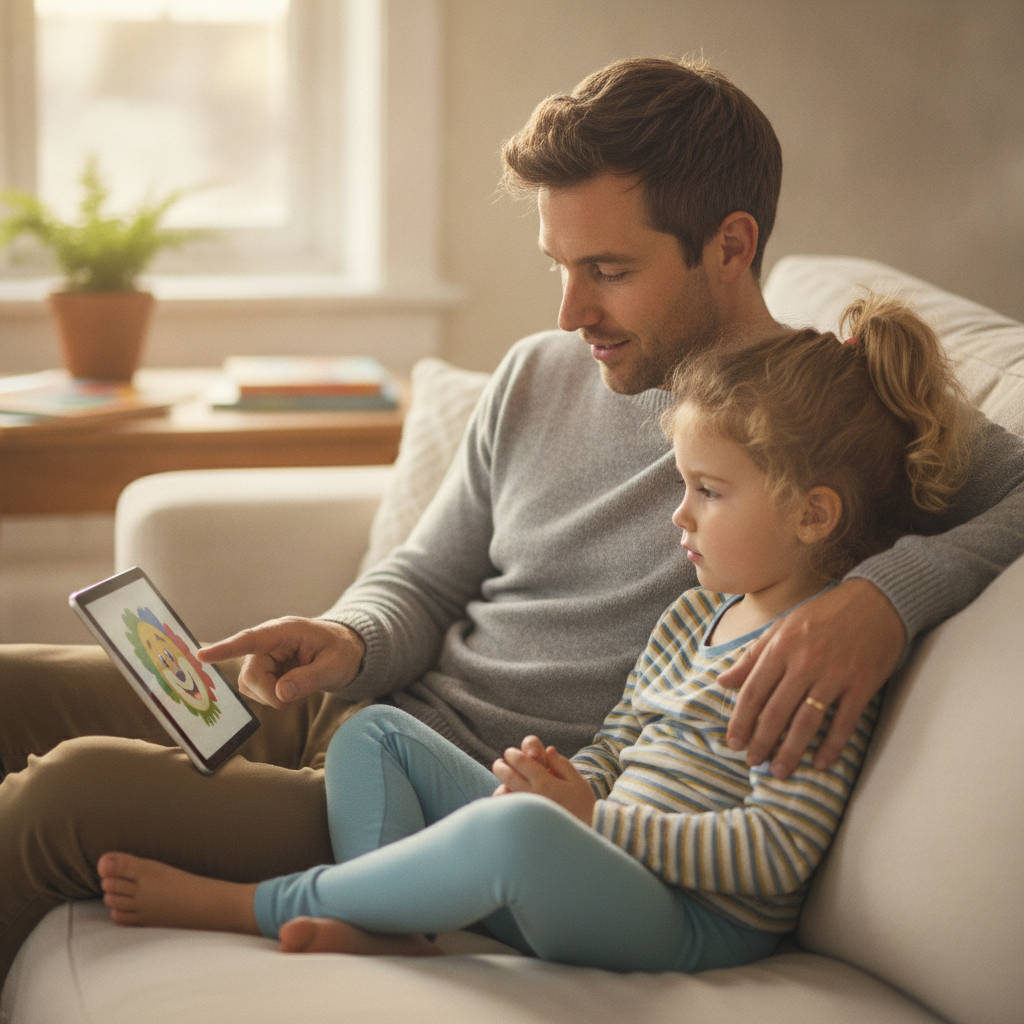
Worth admitting plainly: the list of "signs" above isn't a scientific test — it's just a habit of observation I've built, and it isn't always right. There are small, genuinely hand-made channels that still slip up occasionally; there's also content that used AI tools but still gets carefully reviewed by a real team before it's published. The games I have him play work the same way — they don't turn him into a content-filtering expert, they just build the habit of looking closely before believing. My own role — sitting with him, watching a new channel together for a few minutes before I approve it — is still the part I can't skip.
When I'd ask someone else instead of just worrying alone
If he kept believing something clearly unreal with total certainty despite repeated, age-appropriate explaining, or seemed unusually distressed after watching something (trouble sleeping, prolonged fear), I'd stop guessing and talk to a teacher or pediatrician directly — that's past what a blog post can help with.
Frequently asked questions
So is all AI-made content untrustworthy?
No. As I had to remind myself: a lot of good content — including some cartoons my son already loves — uses AI somewhere in production too, and still gets carefully checked by a real team. What worries me isn't the tool, it's nobody being accountable for what goes out.
Should I just ban anything that looks "off"?
I don't ban it outright — I watch the middle of the video first and ask myself "who's behind this" before deciding. If I'm still unsure, I skip that channel and stick to the ones I've already come to trust.
Do the games you mentioned cost anything or need an account?
No, Wolfoo's browser games are free to play, no install or account needed, designed with child safety in line with COPPA, and show age-appropriate, non-personalized ads.
If you want the technical 30-second checklist, our piece on 6 ways to spot AI slop in kids' videos is the one I go back to most. What Is "Brain Rot" — and Does It Matter for a 5-Year-Old? also helped me worry less about screens in general. And if you've ever had a night where you panicked about your kid glued to a screen, I told that story too, right here.
Sources
- Wolfoo Games Team — 6 Ways to Spot AI Slop in Kids' Videos, on the difference between content that is and isn't checked before publishing.
- Common Sense Media — guidance on evaluating children's media based on who makes it and why, not just the production technology.
This article shares a personal experience and the observations I've drawn from it; it is not a substitute for professional advice. Every family handles what their child watches differently, and there's no single formula that fits all of them.