

My Child Says "You Love My Sibling More": What 10 Minutes a Day Can Do
When your child says you love their sibling more, it's often a request for one-on-one time — not jealousy out of nowhere.
Short answer: when your child blurts out "you love my sister more," it's usually not jealousy out of nowhere. It's a more specific message: your child wants a stretch of time that belongs to them alone, not shared with a sibling. Ten to fifteen minutes of "one-on-one time," done the same way most days, is often enough to make that sentence show up a lot less.
You've probably lived this scene. You're clearing the table, hands full with the baby, when your older one plants themselves in the kitchen doorway and announces, "You always take care of him, not me." You freeze — half guilty, half wrongly accused, because of course you love them both. You explain. It doesn't land. Dinner ends a little heavier than it started.
Why does my child think I play favorites?
According to Shawn Whiteman, a professor of Human Development and Family Studies at Utah State University, that feeling of being loved less rarely comes from parents actually treating kids unfairly. It comes from a child not yet understanding why the treatment differs. The baby gets carried more because the baby is small; the older one gets a later bedtime because they're older — obvious to an adult, but easy for a 4-to-7-year-old to read as "I matter less."
Whiteman also makes a point worth remembering: treating children differently isn't the harmful part, as long as parents explain the reasoning instead of leaving kids to guess. What actually causes harm is comparison and labeling — "why can't you behave like your sister" — because it teaches a child that love is a pie to be divided, and more for one means less for the other.
Your child doesn't need equal — they need to be seen as themselves
A lot of well-meaning parents go sideways here: they try to split everything down the middle — identical toys, minute-for-minute attention — to head off comparisons. But kids aren't actually asking for perfect equality. What they need is the feeling of being noticed as a specific person, with their own interests — not an equal slice of a pie cut three ways. That's why a short block of time that is entirely theirs, spent doing whatever they choose, usually beats a stopwatch-fair split of your attention.
The "special time" technique: 10 minutes a day
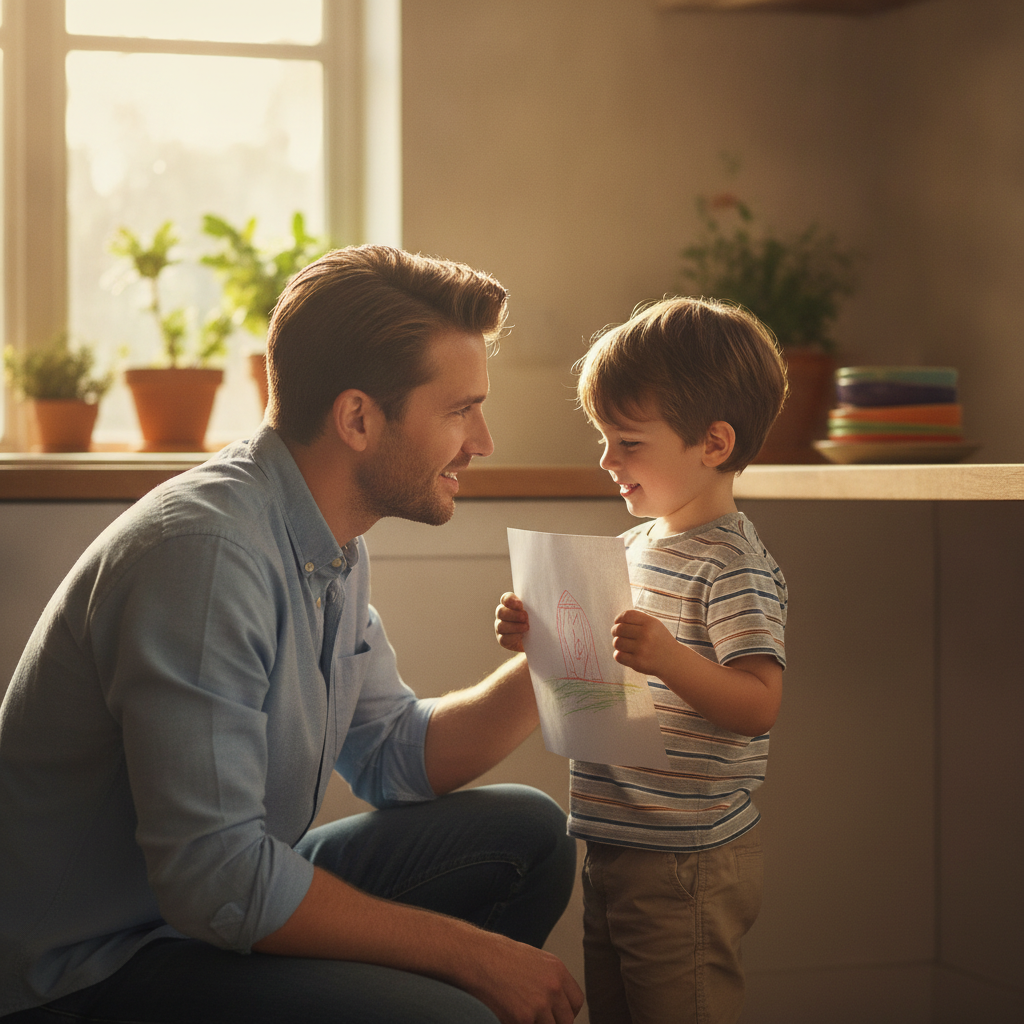
This is a concrete method popularized by psychologist Laura Markham, Ph.D. (author of Peaceful Parent, Happy Kids) and parent educator Patty Wipfler, usually called "special time." The mechanics are simple:
- Set a timer for 10 minutes. Short but reliable beats long but occasional — your child needs to know this time is actually going to happen.
- Let your child pick the activity. No books, no screens, no rule-bound games like a board game with fixed steps — let them lead, even if it looks repetitive or pointless to you.
- Don't correct or teach during this window. This isn't a lesson or a behavior-fixing session. You're there, watching, and joining in on their terms.
- Name what you just did together when the timer ends. "That was fun, building that tower together" helps your child file this moment as theirs.
If you have more than one child, each one needs their own slot — not for perfect fairness, but so each child gets a stretch where they don't have to share you with anyone.
What special time doesn't do
To be honest about it: ten minutes a day won't erase sibling comparisons, and it won't turn a tired, hungry, or overloaded child pleasant on command. Rivalry between siblings is a normal part of growing up, not evidence you're parenting wrong. Special time is a small tool that reduces how much a child needs to compete for attention through comparisons or acting out — it doesn't replace the limits you still have to set, or the real arguments you still have to work through.
One concrete activity for "your child's 10 minutes"
Not sure how to start special time? Letting your child pick a short, free browser game is a reasonable option too, as long as you sit beside them and watch instead of handing over a device and walking away. For an older child who likes a patient, step-by-step challenge, Wolfoo Water Sort Puzzle is a slow-paced color-sorting game that leaves room for your child to narrate what they're thinking. For a younger sibling (ages 3-7), Wolfoo Color Learning is simple and visual, right at the age where "I picked the right color, look!" earns real pride. And if your child likes creating things and showing them off, Lucy's Magical Mermaid lets them design a character their own way — exactly the moment that calls for you to sit down and look closely at what they made.
None of these games "teach" a child out of comparing themselves to a sibling — they're a comfortable excuse to get 10 minutes beside one child, phone down, chores paused. If you're also weighing how much screen time is reasonable, our age-by-age screen time guide can help. And if your kids fight over toys more than they compete for affection, our piece on helping siblings cooperate goes further into that.
When it's worth asking about properly
Most "you love my sibling more" comments are simply a child's way of asking for attention, and they usually soften once one-on-one time becomes a reliable habit. A few signs are worth raising with a teacher or a child psychologist rather than waiting out:
- Your child says they're "not loved" or "don't matter" persistently, over weeks, not just in the heat of an argument.
- Your child talks about hurting themselves, or says things that genuinely worry you about how they're feeling.
- Your child withdraws from the whole family, not just from one sibling.
- You notice you genuinely do treat your kids very differently, without a reason you could explain to them — worth an honest look at yourself.
FAQ
At what age does a child understand one-on-one time?
From around age 3, kids can tell the difference between "time with the whole family" and "time when it's just me and Mom." The core idea — they choose, you follow — works from that age on.
If I only have 10 minutes a day, how do I split it between kids?
Each child gets their own slot, even if it's just 5 minutes. Combining it into "10 minutes for both kids together" loses the one-on-one feeling the technique is built around.
Can a game replace special time?
No. A game is just something to do together; what makes the difference is you sitting beside your child, paying attention, and not doing anything else at the same time.
My child still compares themselves to their sibling even after special time — am I doing something wrong?
Not necessarily. Sibling comparison is normal and fades gradually, not overnight. Staying consistent matters more than expecting an immediate result.
Sources
- Shawn Whiteman, Professor of Human Development and Family Studies, Utah State University — interview on sibling rivalry (USU Today, "Ask an Expert: Navigating Sibling Rivalry").
- Laura Markham, Ph.D. — author of Peaceful Parent, Happy Kids: How To Stop Yelling and Start Connecting, on structuring "special time" with a child.
- Patty Wipfler — parent educator who popularized the "special time" technique (as reported by Today's Parent).
This article is general guidance for parents and is not a substitute for assessment by a qualified child psychologist or educator.